Why Your Suppliers Are the Biggest Risk in Your AI Adoption Strategy (And How to Solve It Without Asking Them to Change Anything)

Noam Shakuri
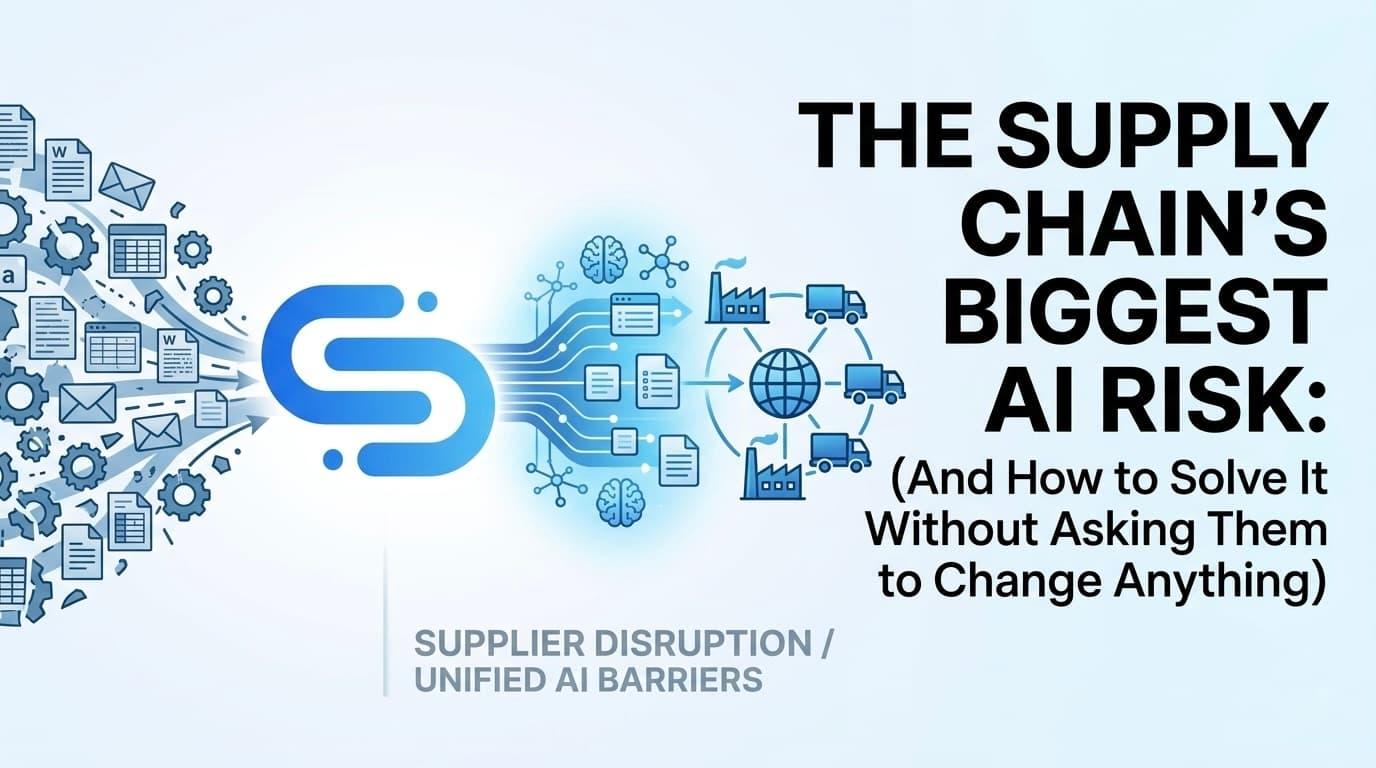
There is a presentation that procurement leaders at large manufacturers have sat through hundreds of times. The slides look slightly different each time, but the story is always the same.
Slide 1: Current state. Hundreds of suppliers. Email chaos. No visibility. Manual data entry. Time wasted.
Slide 2: Future state. One platform. All suppliers. Real-time status. Automated workflows. Strategic procurement team.
Slide 3: Implementation plan. Q1: onboard Tier 1 suppliers. Q2: extend to Tier 2. Q3: full rollout. Q4: steady state.
The presentation is compelling. The procurement leader approves the budget. The project kicks off.
Eighteen months later, 40 of the top 50 suppliers are on the platform. Suppliers 51 through 500 are still sending emails. The implementation team has moved on. The "steady state" in Q4 was quietly redefined to mean "we're done trying to onboard more suppliers." The supplier relationship management that was supposed to happen on the new platform is still happening in email, because that's where the suppliers are.
This is not a story about a bad product. It is a story about a structural problem that has derailed every procurement platform rollout for the past 25 years. And it is the most important design consideration that procurement leaders are not asking about when they evaluate AI tools.
The Supplier Adoption Graveyard
The gap between supplier portal vision and supplier portal reality is one of the most consistently documented phenomena in enterprise procurement technology. The industry has been measuring it for two decades, and the numbers have not improved materially.
Ardent Partners' annual research consistently reports that supplier portal adoption at most enterprises peaks in the 20 to 35% range for active supplier bases. The Hackett Group's procurement benchmarking data shows similar patterns: despite significant technology investment, the majority of supplier communication at most manufacturers still occurs outside the system of record, in email and phone calls.
The 20 to 35% adoption figure is not a failure of implementation effort. It reflects a structural reality about who is in a manufacturer's supply base and what those suppliers are realistically able to do.
The adoption curve is predictable:
Tier 1 suppliers (top 5 to 10% by spend): Large, sophisticated, often publicly traded companies with dedicated IT and procurement teams. They have the resources to integrate with customer portals. They typically adopt, with some friction and timeline slippage.
Tier 2 suppliers (next 15 to 20% by spend): Mid-size companies with moderate IT capability. They can adopt if sufficiently motivated. Adoption depends heavily on relationship strength and the customer's willingness to invest in onboarding support. Partial adoption.
The long tail (remaining 70 to 80% by spend and 90%+ by supplier count): Small and mid-size businesses, often regional or international, with limited IT resources. A small injection molding shop in Ohio. A specialty chemical supplier in Germany. A packaging manufacturer in South Korea. These companies cannot maintain portal integrations for every customer they serve. They communicate by email because email works everywhere, costs nothing, and requires no IT overhead.
The math is uncomfortable: the 20 to 35% of suppliers that adopt a portal typically represent a disproportionate share of spend — but the long tail represents the majority of supplier relationships and, in many cases, the most fragmented, least-monitored supply risk. The companies that the portal doesn't reach are often the ones that most need monitoring.
Why Suppliers Resist
The problem is not that suppliers are resistant to technology or change. Most suppliers would prefer a simpler, cleaner communication process with their customers. The problem is that the cost of portal adoption falls entirely on the supplier, while the benefit flows entirely to the customer.
Consider what portal adoption actually requires of a small supplier:
IT resource investment. Someone at the supplier company has to set up the portal account, learn the interface, and figure out how to enter data in the format the portal requires. For a company of 20 people where the "IT team" is the owner's nephew who also does sales quotes, this is not a trivial ask.
Credential management overhead. A supplier with 30 large customers may be expected to maintain 30 different portal logins, across 30 different interfaces, each with its own data format and workflow. The marginal cost of adding the 31st portal is not zero — it is the IT time to set it up, the training time to learn it, and the ongoing overhead of checking yet another platform for new requests and acknowledgments.
Process disruption. The supplier's existing workflow — receive email, check order, reply — is established and efficient for them. Adopting a portal means breaking that workflow and replacing it with a new one. There is no direct benefit to the supplier from this disruption. The portal benefits the customer.
Language and timezone barriers. A procurement portal designed and hosted in English, maintained on US business hours, presents additional friction for suppliers in Germany, Taiwan, India, or Brazil. Supplier support for portal issues is typically in the customer's language, not the supplier's.
None of these obstacles are insurmountable for a supplier with resources. All of them are meaningful barriers for a supplier without them. And the suppliers without resources are the ones the manufacturer least controls and most needs to monitor.
The EDI Trap
Before supplier portals, the standard solution to the structured supplier communication problem was EDI: Electronic Data Interchange. EDI solved a real problem for a specific subset of supplier relationships, and it is still in use today. It is also, for the purposes of this discussion, a useful illustration of what happens when you design a supplier communication solution around technical capability rather than supplier reality.
EDI works — genuinely well — when:
- Both parties have invested in EDI infrastructure
- The transaction types are standardized (purchase orders, acknowledgments, advance ship notices)
- The data formats don't change frequently
- Transaction volume is high enough to justify the per-trading-partner implementation cost
- Both parties have IT resources to maintain the integration
These conditions hold for approximately 5 to 10% of a typical manufacturer's supplier base — the largest, most sophisticated, highest-volume relationships. For those relationships, EDI delivers excellent results: high-speed, structured, automated data exchange with near-zero manual intervention.
For the other 90 to 95%, EDI is not a viable option. The cost to implement EDI per trading partner ranges from $10,000 to $50,000+ depending on complexity, and requires ongoing technical maintenance on both sides. The ROI case breaks for any supplier relationship below a certain transaction volume threshold. Small suppliers don't have the technical resources to implement EDI even if the customer offers to pay for it. And EDI's rigid structure makes it poorly suited for the exception-heavy, format-variable communication that characterizes active direct procurement management.
The result is a two-tier supply chain communication architecture that every manufacturer understands but rarely acknowledges explicitly: EDI for the top 5%, email for everyone else. The "everyone else" is where most of the supplier management challenge lives.
Email Is the Universal Protocol
Here is the uncomfortable truth that the enterprise software industry has been slow to accept: email is not a problem to be solved. It is a protocol to be built on.
Every supplier in the world uses email. The $2 billion tier-1 contract manufacturer in Malaysia. The $200,000 specialty fastener shop in Ohio. The family-owned raw material supplier in Germany with 12 employees. The component distributor in Taiwan who handles orders for 80 different customers. All of them have email. All of them check it. All of them can receive, read, and reply to email without any investment in new infrastructure, without any training, and without any change to how they operate.
Email is the only supplier communication channel that achieves 100% supplier coverage by default. Not because it is the best technology — it is not. Because it is the only universal technology. It works across every geography, every company size, every language, every technical capability level.
The procurement automation industry has spent 30 years trying to get suppliers off email and onto platforms. The premise of this effort is backwards. The right design question is not "how do we get suppliers to use our platform?" It is "how do we automate procurement operations without requiring suppliers to change anything?"
The answer is to build the AI at the receiving end of the email — on the buyer's side, not the supplier's — and let suppliers keep emailing exactly as they always have.
How Evolinq Is Built Around Supplier Reality
Evolinq's architecture starts from a principle that sounds simple but has significant design implications: the supplier experience should not change.
When a supplier sends a delivery confirmation to a buyer who uses Evolinq, several things happen on the buyer's side that the supplier never sees:
- The email is received by Evolinq's agent, which reads it using NLP — understanding the confirmed quantities, delivery date, and any exceptions the supplier mentioned.
- The agent cross-references the confirmed data against the open PO in the ERP.
- If it's a routine confirmation within normal parameters, the agent updates the ERP, sends the supplier an acknowledgment, and logs the interaction.
- If it's an exception — a delay, a partial shipment, a pricing discrepancy — the agent evaluates whether it falls within autonomous handling parameters or requires buyer attention, and routes accordingly.
None of this involves the supplier doing anything differently. The email they sent is the same email they would have sent without Evolinq. The acknowledgment they receive comes from the buyer's email address in the format they're used to. From the supplier's perspective, nothing has changed. The responses come faster and more consistently — that's the only observable difference.
This design means that Evolinq achieves supplier coverage equivalent to the buyer's email reach. If the buyer can receive email from a supplier, Evolinq can process and act on that supplier's communications. Coverage is 100% on day one, not 35% after 18 months.
The Deployment Contrast
The operational difference between a traditional supplier portal deployment and an Evolinq deployment is not a matter of degree. It is a categorical difference in what implementation requires.
| Factor | Traditional Supplier Portal | Evolinq |
|---|---|---|
| Supplier onboarding required | Yes — each supplier individually | No — zero supplier action needed |
| Implementation timeline | 6–18 months | 1–5 business days |
| Dedicated change management team | Required | Not required |
| Supplier IT resources needed | Yes | No |
| Supplier training required | Yes | No |
| Ongoing supplier support overhead | Significant | None |
| Language/timezone accommodation | Required per region | Handled by NLP layer |
| Supplier coverage on day 1 | ~5–10% (Tier 1 only) | 100% |
| Supplier coverage at 12 months | 20–35% (typical) | 100% |
| Coverage of long-tail suppliers | Near zero | Full |
The supplier coverage numbers are the ones that matter most for ROI. A procurement automation tool that covers 20% of the supplier base automates 20% of the problem. The other 80% of supplier interactions — the volume, the exceptions, the data entry — remains manual. The tool is useful. It is not transformative.
A tool with 100% coverage automates the entire problem from day one. The cost savings, visibility improvements, and exception handling benefits apply across the full supply base, not a preferred subset of it.
The Long-Tail Supplier Problem
Most technology investment in procurement follows spend concentration. The top 10 suppliers by spend receive the most attention, the most integration effort, and the most visibility. This is rational from a spend management perspective — those relationships represent the most economic value.
It is often wrong from a supply risk perspective.
Supply disruptions rarely originate from the largest, most monitored suppliers. They originate from smaller, less-managed suppliers — the component specialist with a single production line, the raw material supplier in a weather-exposed region, the packaging supplier who is also serving three of your competitors and may allocate away from you if demand spikes.
These tail suppliers are exactly the ones that portal-based and EDI-based automation fails to reach. They are also the ones where Evolinq's coverage-by-default architecture delivers the most distinctive value. On the day Evolinq goes live, every supplier in the buyer's email contacts — supplier number 1 and supplier number 847 — is covered. The small regional supplier who sends handwritten confirmations in Spanish is processed the same way as the Fortune 500 distributor with a structured confirmation format.
The procurement team that has real-time visibility into its full supplier base — including the tail — is operating a materially different risk posture than the team that has visibility into its top 50. Most supply surprises come from the part of the supply base you're not watching. Evolinq watches all of it.
What This Means for AI ROI
The ROI calculation for any procurement AI tool depends critically on one variable that most evaluations underweight: supplier coverage.
The theoretical value of a procurement AI tool is the total time and cost reduction it enables if applied to the full supplier communication volume. But the realized value is theoretical value multiplied by the percentage of supplier interactions it actually covers.
Tool with 35% supplier adoption: 35% of theoretical value. Tool with 100% supplier coverage: 100% of theoretical value.
This is not a subtle difference. It means that a procurement AI tool requiring supplier adoption can only justify its cost on the basis of the 35% of supplier interactions it manages — which means the ROI case is built on a fraction of the actual problem. For the ROI case to hold, the tool needs to generate extraordinary value from the minority of interactions it covers to compensate for the majority it doesn't touch.
There is a second-order effect that is equally important: the supplier interactions that require the most human attention are typically the ones with less-managed suppliers — the tail. A tool that covers only the top suppliers automates the easiest interactions (large suppliers with structured communication) and leaves the hardest interactions (small suppliers with inconsistent formats, more exceptions, less predictable behavior) entirely manual.
A tool with 100% supplier coverage, by contrast, automates both the easy and the hard interactions. The AI is managing the full distribution of supplier communication complexity, not just the structured end of it. The ROI is calculated against the full problem, not a preferred subset.
At RH Electronics, Evolinq achieved 100% supplier coverage on day one across more than 1,000 active suppliers. The deployment team did not contact a single supplier. No onboarding materials were prepared. No training sessions were held. Suppliers received the same emails from the same contacts they had always worked with. The transformation happened entirely on the buyer's side.
The Question to Ask Every AI Procurement Vendor
When evaluating any AI procurement tool, one question cuts through the product demonstrations and ROI projections faster than any other:
"What does my supplier have to do for this to work?"
If the answer involves any of the following — logging into a portal, adopting a new format, implementing an API connection, registering for an account, attending a training session — the answer is that your supplier has to do something. And the percentage of your suppliers who will actually do that something determines the ceiling on the tool's real-world value.
If the answer is "nothing — your suppliers keep emailing exactly as they always have," then supplier adoption is not a risk. Coverage is guaranteed from day one. The ROI case is built on the full supplier base, not a preferred subset.
Most procurement AI tools cannot give this answer because they were not designed with supplier reality as the primary constraint. They were designed around what the AI can do, and then the supplier adoption challenge was treated as an implementation problem to be solved after the fact.
Evolinq was designed in the opposite order. The constraint came first: the system must work for every supplier in the buyer's network, regardless of size, language, technical capability, or existing workflow. The architecture — NLP on inbound email, response generation from the buyer's address, ERP integration on the buyer's side — follows from that constraint.
The result is a procurement AI that your suppliers will never know is there. And that is precisely the point.
See how Evolinq achieved 100% supplier coverage at RH Electronics on day one — book a demo.