SAP Ariba vs. AI Agents for Direct Procurement: Why They're Not Actually Competing for the Same Problem

Noam Shakuri
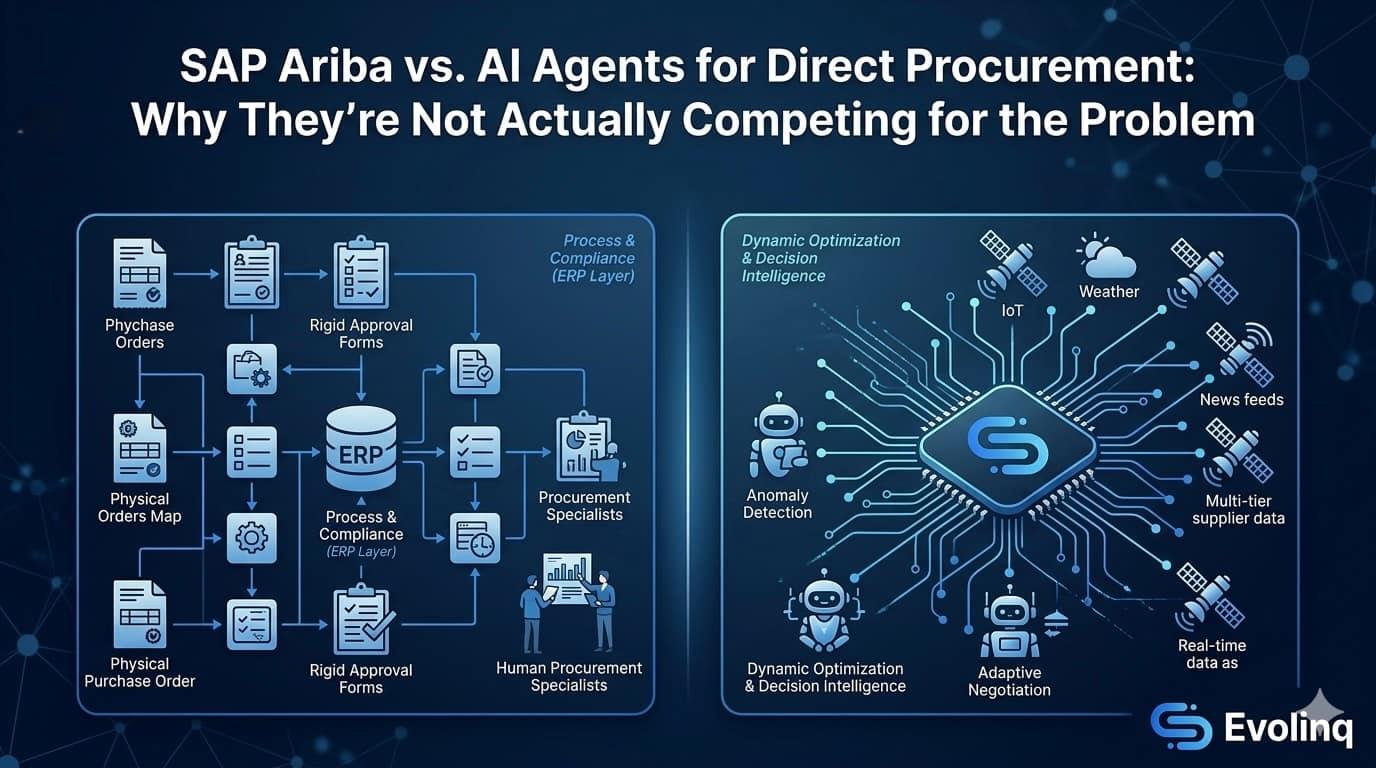
When procurement and IT leaders at SAP shops hear that Evolinq is an AI platform for procurement, they ask a predictable question: "We already have SAP Ariba. Why would we need something else?"
It is a fair question. SAP Ariba is one of the most widely deployed procurement platforms in the world. If you have invested in it, it seems reasonable to assume that your procurement automation needs are covered. The question deserves a direct answer.
The short answer: Ariba and Evolinq are not competing for the same problem. Ariba is a strategic sourcing and indirect spend platform. Evolinq is an autonomous execution layer for direct procurement. Buying Evolinq when you have Ariba is not redundant — it is filling a gap that Ariba was never designed to fill, and that SAP's core ERP does not address.
The longer answer requires understanding what each system actually does, what it was built for, and where the operational gaps live in a typical SAP environment.
What SAP Ariba Actually Does Well
SAP Ariba is genuinely excellent at the problems it was designed to solve. Understanding where it succeeds is necessary context for understanding where the gaps are.
Strategic sourcing. Ariba's sourcing capabilities — RFQ management, e-auction tools, bid analysis, supplier qualification — are mature and comprehensive. For a procurement team managing a complex sourcing event for a major category, Ariba provides the workflow, collaboration, and analytics infrastructure to run it well. This is core Ariba functionality, and it is good.
Contract management. The contract lifecycle management module in Ariba — drafting, negotiation, approval workflow, repository, compliance monitoring — is a serious capability that large organizations depend on. Contract compliance tracking and obligation management are areas where Ariba delivers real value.
Indirect spend management. This is arguably Ariba's home territory. Indirect procurement — facilities, IT, marketing spend, travel, professional services — involves highly distributed buyers across the organization, a need for catalog-based purchasing, and policy enforcement. Ariba's guided buying, catalog management, and approval workflow capabilities were built precisely for this use case.
Supplier discovery and onboarding. The Ariba Network provides access to a large supplier database, supplier performance data, and a structured onboarding workflow. For organizations that regularly add new suppliers to their indirect or strategic sourcing programs, this is a meaningful capability.
Compliance and audit workflows. Three-way matching for indirect spend, budget controls, policy enforcement, and audit trail generation are well-developed in Ariba. For finance and compliance teams that need visibility into spend compliance, Ariba's reporting and control capabilities are substantial.
This is not a platform to dismiss. For what it does, it does it well.
What SAP Ariba Doesn't Address
The gaps in Ariba's coverage are not design failures — they are design choices. Ariba was built for strategic and indirect procurement. Direct procurement operational execution was not the use case it was optimized for.
Daily operational supplier communication for direct procurement. Running direct procurement at a manufacturer means sending hundreds or thousands of POs to suppliers, receiving acknowledgments, managing delivery confirmations, handling partial shipments, and expediting late orders — every day, at scale. Ariba does not provide workflow for this kind of high-frequency, transactional supplier communication. It was not designed to.
Automated supplier response management. When a supplier sends an email acknowledging a PO, noting a delivery delay, or flagging a quantity shortage, Ariba has no native mechanism to read that email, extract the relevant data, and update the corresponding PO record automatically. The information flow between supplier email and ERP record requires human intervention.
PO tracking at scale. Monitoring the status of hundreds of open POs simultaneously — which have been acknowledged, which are on track, which are at risk — is not a native Ariba capability in the direct procurement operational context. Ariba's visibility tools are designed for sourcing events and contract compliance, not for real-time operational order management.
Goods receipt automation. The workflow between supplier delivery confirmation and goods receipt posting in SAP (MIGO/GR posting) is a manual process in most SAP environments. Ariba does not bridge this gap.
Long-tail supplier management. Ariba's supplier capabilities are most effective for large, structured supplier relationships that can integrate with the Ariba Network. The long tail of smaller, regional, or international suppliers who communicate by email — the majority of most manufacturers' supplier bases — is operationally unaddressed.
None of this is a criticism of Ariba. These are simply not the problems it was designed to solve.
The SAP Core ERP Layer: The Gap Nobody Talks About
SAP's ERP (typically S/4HANA or ECC, using the MM module for materials management) is the system of record for procurement transactions. When a purchase requisition is created and converted to a PO, SAP records that event. When goods are received, MIGO posts the goods receipt. When an invoice arrives, it is matched against the PO and GR in the invoice verification process.
What SAP core does not do is manage the operational workflow between those recorded transactions.
The PO is issued in SAP. That is a recorded event. The supplier receives the PO, reviews it, confirms it, ships the goods, and delivers them. Those are the operational steps — and they happen outside SAP, in email and phone calls, until a human manually enters the results back into SAP.
The gap between "PO issued in SAP" and "goods receipt posted in SAP" is a sequence of operational steps that SAP's standard functionality does not address:
- PO transmitted to supplier (manual or EDI for the top 5%)
- Supplier acknowledgment received and logged (manual)
- Delivery date tracked against expected date (manual)
- Follow-up sent when no acknowledgment received (manual)
- Delivery exception identified and escalated (manual)
- Revised delivery date received and updated in SAP (manual)
- Delivery confirmation received (manual)
- GR posted in MIGO (manual)
Steps 1 through 7 are entirely unaddressed by SAP's standard MM module for the vast majority of supplier relationships not on EDI. MRP can trigger a requisition and convert it to a PO. It does not manage the supplier communication that needs to happen for that PO to be fulfilled on time.
This is not a gap that SAP has overlooked. It is a gap that the entire ERP industry has left to manual human effort for 30 years, on the assumption that supplier communication is too variable and unstructured to automate. That assumption is no longer valid.
Where Evolinq Plugs In
Evolinq is designed to operate precisely in the gap that SAP's standard functionality does not address — the operational workflow between PO issuance and goods receipt.
The integration model is straightforward:
SAP as the source of truth. Evolinq reads open POs directly from SAP via API or file-based integration (compatible with S/4HANA, ECC, and other SAP versions). The data in SAP — PO numbers, quantities, delivery dates, supplier details, item descriptions — is the foundation for everything Evolinq does.
Evolinq as the operational execution layer. Once a PO is ingested from SAP, Evolinq's AI agents manage the supplier communication workflow autonomously: transmitting the PO to the supplier, monitoring for acknowledgment, sending follow-ups, parsing supplier responses using NLP, identifying exceptions, escalating when warranted, and logging all interactions.
Real-time write-back to SAP. When Evolinq receives a supplier confirmation with an updated delivery date, that data is written back to the corresponding SAP PO record in real time — no manual entry required. When a goods receipt is confirmed, the agent can trigger or support the MIGO posting workflow. ERP data quality improves as a direct result of eliminating the manual transcription step.
This is a complementary architecture, not a competing one. Ariba handles strategic sourcing and contract management. SAP core handles transactional recording. Evolinq handles the operational execution between transaction creation and transaction completion.
Comparison: SAP Ariba vs. Evolinq vs. SAP Core ERP
| Capability | SAP Ariba | SAP Core ERP (MM) | Evolinq |
|---|---|---|---|
| Strategic sourcing (RFQ, e-auction) | ✅ Primary capability | ❌ | ❌ |
| Contract management | ✅ Primary capability | Limited | ❌ |
| Indirect spend management | ✅ Primary capability | Partial | ❌ |
| Supplier discovery / Ariba Network | ✅ | ❌ | ❌ |
| PO transaction recording | Partial | ✅ System of record | ❌ |
| MRP-driven requisition / PO creation | ❌ | ✅ | ❌ |
| Direct procurement operational execution | ❌ Not designed for this | ❌ Gap in standard functionality | ✅ Primary capability |
| Automated supplier email communication | ❌ | ❌ | ✅ |
| NLP parsing of supplier responses | ❌ | ❌ | ✅ |
| PO tracking at scale (all suppliers) | ❌ | ❌ | ✅ |
| ERP data sync (write-back) | Partial (Ariba Network) | N/A (is the ERP) | ✅ Real-time |
| Supplier adoption requirement | High (Ariba Network portal) | EDI for top suppliers | None — suppliers use email |
| Deployment timeline | 6–18 months | Varies (existing) | 1–5 days |
| Long-tail supplier coverage | Low | N/A | 100% |
The table makes the complementarity clear. These three systems occupy different layers of the procurement technology stack. Deploying all three is not redundancy — it is complete coverage.
Real-World Scenario: Where SAP Ariba Ends and Evolinq Begins
Walk through a typical direct procurement cycle at a mid-size electronics manufacturer running SAP S/4HANA and SAP Ariba:
Strategic sourcing (Ariba handles this): The category manager runs a sourcing event for a new component supplier. RFQ is issued through Ariba. Bids are received and evaluated. A supplier is selected. The contract is executed and stored in Ariba's contract repository. The supplier is added to the approved supplier list in SAP.
MRP-driven PO creation (SAP core handles this): The production planning team runs MRP. A material shortage is identified. A purchase requisition is created automatically. The procurement team converts it to a PO in the MM module. The PO is approved through SAP's approval workflow.
This is where the gap opens. The PO is now sitting in SAP as an open document. Someone needs to send it to the supplier, monitor that the supplier receives and acknowledges it, track whether the confirmed delivery date is realistic, follow up if acknowledgment doesn't arrive, handle the supplier's response when they say they can only deliver 800 units instead of 1,000, update the PO in SAP to reflect the revised quantity and date, and post the goods receipt when delivery occurs.
In a typical SAP environment without Evolinq, every step of this is manual. A buyer sends the PO by email. They check back a few days later to see if there's a confirmation. They manually update the SAP PO record with the confirmed date. When the delivery arrives two days late, someone posts MIGO manually. The procurement team has done this for every PO, for every supplier, at whatever scale the organization operates.
Evolinq handles this entire sequence autonomously. The PO is transmitted to the supplier immediately after creation in SAP. Acknowledgment is tracked. If no acknowledgment arrives within the defined window, Evolinq sends a follow-up. The supplier's email response is parsed by NLP — confirming 800 units instead of 1,000 triggers an exception alert to the buyer with the full context. The revised quantity and date are written back to the SAP PO record without manual entry. The buyer's attention is required only for the exception that warrants it.
After delivery (SAP core handles this again): Goods receipt is posted in MIGO. Invoice is matched. Payment is processed. Ariba's contract compliance tracking captures whether the supplier met contractual delivery performance.
The seam is clean. Ariba owns the strategic and contractual layer. SAP core owns the transactional record. Evolinq owns the operational execution in between.
ROI of Adding Evolinq to an Existing SAP Environment
Organizations that have deployed Evolinq in SAP environments report consistent improvements across four dimensions:
Reduction in manual procurement hours. The operational execution tasks that Evolinq handles — PO transmission, acknowledgment tracking, follow-up emails, response parsing, data entry — represent 60 to 70% of operational procurement team time at most organizations. Eliminating this manual work across a full supplier base translates to significant headcount redeployment toward strategic work, or genuine cost reduction in operational procurement staffing.
ERP data quality improvement. When supplier confirmation data is written back to SAP automatically — confirmed quantities, revised delivery dates, shipping details — the accuracy of that data improves and the lag between supplier communication and ERP update is eliminated. Downstream processes that depend on SAP data quality — MRP re-runs, available-to-promise calculations, production scheduling — operate on more accurate, more current information.
Reduction in supplier communication errors. Manual transcription of supplier email data into SAP is a significant source of data entry errors: wrong delivery dates, incorrect quantities, mismatched PO numbers. Eliminating the manual transcription step eliminates the error class. Organizations typically report a 70 to 90% reduction in supplier-communication-related data entry errors after deployment.
Faster PO-to-delivery cycle time. When acknowledgment follow-ups are automated and exceptions are identified and escalated within hours rather than days, the total cycle time from PO issuance to confirmed delivery shortens. Early identification of delivery risk — a supplier flagging a two-week delay on day three rather than day twelve — creates options for the procurement team to find alternatives, adjust production schedules, or expedite from secondary sources while there is still time to act.
The Right Question to Ask
The question for SAP procurement leaders is not "should we replace Ariba with AI?" It is "what is Ariba not covering, and what is the cost of leaving that gap unaddressed?"
For most manufacturers, the gap is the entire operational execution layer of direct procurement — the daily supplier communication, the PO tracking, the exception management, the ERP data maintenance that happens between strategic sourcing events. Ariba has never addressed this layer. SAP core records transactions but does not manage the workflow between them.
Evolinq fills that specific gap — integrating with SAP as the operational execution layer that SAP doesn't provide, reading POs from SAP, managing supplier communication autonomously, and writing confirmed data back to SAP in real time.
If you are running SAP and your buyers are still manually sending PO emails, tracking acknowledgments in spreadsheets, and entering supplier confirmation data into SAP — the gap is real and the cost is measurable. Adding Evolinq is not replacing anything you have. It is completing the stack.