The Procurement Team of 2030: What AI Agents Mean for the Humans Who Do This Work

Noam Shakuri
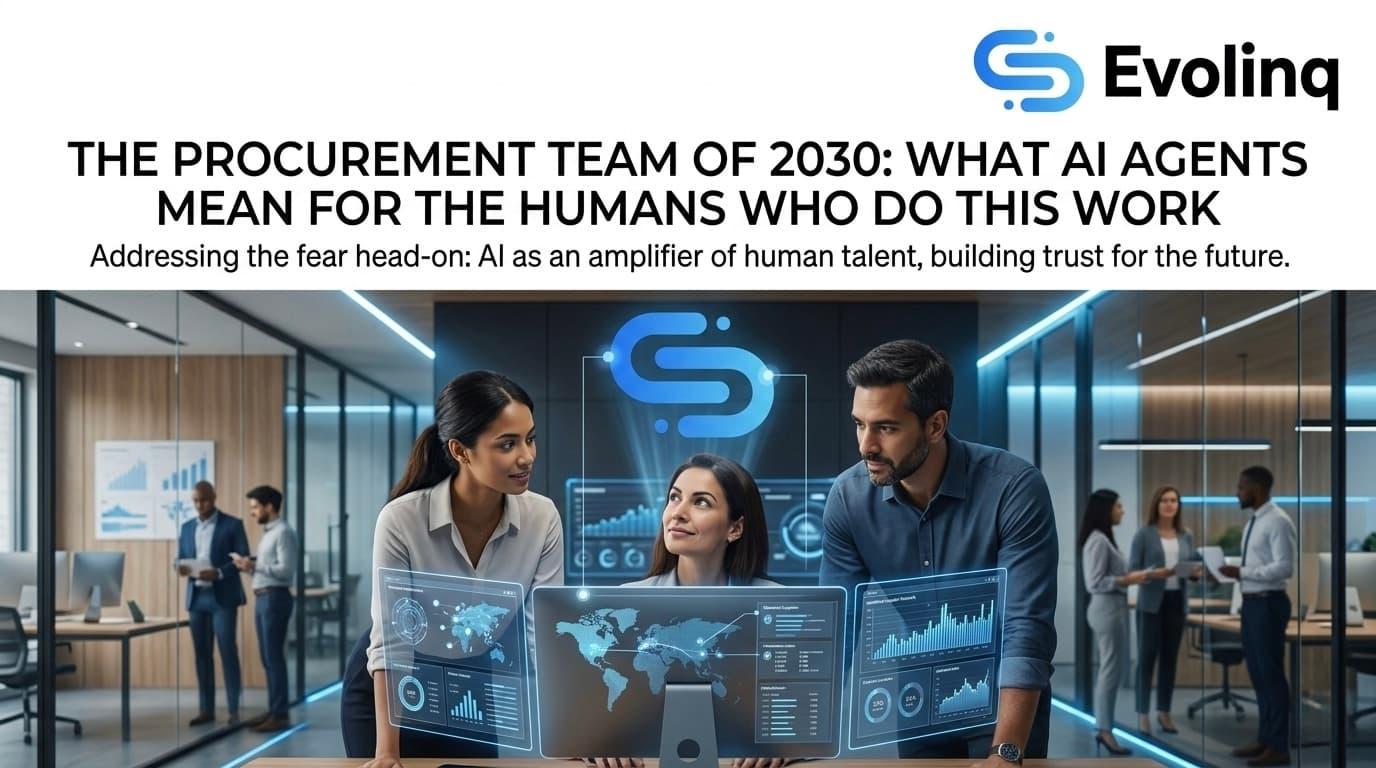
Let's start with the question that nobody in procurement is asking out loud but everyone is thinking privately: Am I going to be replaced by AI?
It is a reasonable thing to wonder. You have watched AI automate legal document review, financial analysis, customer service, and software code generation. You have read the headlines about headcount reductions at companies deploying automation. You have sat through vendor presentations where the phrase "autonomous AI agents" appears next to graphs showing efficiency gains that imply doing the same work with fewer people.
So the question is not paranoid. It is rational. And it deserves a direct, honest answer rather than the reassuring non-answer that most technology vendors give when this subject comes up.
Here is the direct answer: AI agents will not eliminate your job. They will eliminate a significant portion of what you currently spend your day doing. Whether that turns out to be liberation or displacement depends almost entirely on what you do with the time that gets freed up — and on the choices your organization makes about what procurement teams are actually for.
This is a piece about those choices. About what the procurement function actually looks like in 2030, what skills matter, what the org chart shifts look like, and how to position yourself to be on the right side of the transition. It is written with genuine respect for the profession — not to sell you something, but because the people who do this work deserve a clearer view of what is coming than most of the coverage provides.
The Honest Truth About What AI Agents Are Replacing
The first thing that matters is specificity. "AI will change procurement" is not useful information. What AI agents will actually handle, in concrete operational terms, is:
Purchase order dispatch and acknowledgment tracking. Sending POs to suppliers, monitoring for acknowledgments, following up when acknowledgments don't arrive, logging confirmation data back into the ERP. This is a process that, at a manufacturer with 500 active suppliers and regular purchase cycles, consumes hours of buyer time every week — not because any individual task is complex, but because there are hundreds of them.
Delivery follow-up and expediting. Checking on open orders that are approaching their delivery date. Sending status request emails. Following up when the status reply doesn't arrive. Escalating to a human when the supplier response indicates a problem. This is the category of work that many procurement professionals describe as the "inbox management" portion of their role — the volume of which can crowd out everything else.
ERP data entry. Taking information from supplier emails — confirmed quantities, revised delivery dates, new pricing — and entering it into the ERP system. Manual data entry between supplier communications and ERP records is one of the most time-intensive and error-prone tasks in direct procurement.
Routine supplier queries. "What is the lead time for an order placed today?" "Can you provide a revised delivery date for PO 40023?" "We need an updated CoC for this component." These are legitimate, necessary interactions — and they are also highly templatable, high-volume, and time-consuming to manage at scale.
Shortage alerts and exception identification. Monitoring open orders for patterns that indicate supply risk — supplier acknowledgment delays, delivery date slippage, partial shipment flags — and surfacing exceptions for human review. In a procurement team managing hundreds or thousands of open orders simultaneously, manual monitoring of this kind is impossible to do comprehensively.
Invoice matching and discrepancy flagging. Three-way matching between PO, delivery receipt, and invoice; identifying discrepancies; routing for resolution. Routine for AI; time-consuming for humans.
Research consistently quantifies how much of a procurement professional's week these tasks consume. A Hackett Group analysis found that transactional and operational tasks — the category that encompasses everything listed above — accounts for 60 to 70% of total procurement team time at most organizations. McKinsey's operations automation research identifies data collection, data processing, and predictable physical work as the highest-automation-potential categories, and the majority of operational procurement activities fall into these buckets.
What this means practically: if you are a buyer at a mid-size manufacturer today, somewhere between 60 and 70% of what you do on a typical Tuesday is potentially automatable with current AI agent technology. Not someday. Now.
That is a large number. It warrants acknowledgment, not minimization.
What Doesn't Get Replaced
The 30 to 40% that remains — and that AI cannot do — is the part of procurement that requires things that AI is genuinely not equipped to provide.
Supplier relationships that require human judgment. The difference between a negotiation with a key supplier that goes well and one that goes badly often has nothing to do with the numbers. It has to do with trust, history, relationship dynamics, and the ability to read a room. A 15-year relationship with a critical component supplier is not something an AI agent maintains. The human who has been on that supplier's shop floor, who knows their production capacity limits from direct observation, who has helped them through a difficult period — that person is irreplaceable in managing the relationship at the moments that matter.
Strategic sourcing and supplier development. Selecting a new supplier for a strategic category involves judgment calls that cannot be fully systematized: assessing cultural fit, evaluating management depth, forming a view on financial stability beyond what credit ratings capture, deciding whether a smaller supplier's innovation roadmap justifies the risk of a new relationship. AI can surface information and model scenarios. The strategic call is a human call.
Crisis management. When a key supplier shuts down unexpectedly, when a natural disaster disrupts a supply region, when a geopolitical event suddenly puts a material source at risk — these situations require a human decision-maker who can gather information quickly, make judgment calls under uncertainty, and sometimes get on a plane. Crisis procurement is not automatable. It is also, in retrospect, often where the most important procurement work happens.
Category strategy. A category strategy that makes your organization genuinely competitive — that balances cost, quality, risk, innovation access, and supply resilience in a way that fits your business — is a strategic artifact. AI can model scenarios, analyze spend data, and benchmark against market. The strategy is a human creation.
Risk intuition. Geopolitical risk, regulatory risk, reputational risk, supplier financial risk — these require not just data analysis but contextual judgment that is difficult to formalize. The procurement leader who senses that a supplier's financial situation has changed before it shows up in public data, or who identifies a regulatory development that will affect a supply chain two years from now, is exercising a form of judgment that AI does not replicate.
The pattern across all of these is consistent: what AI doesn't replace is judgment, relationship, and strategy. What it does replace is execution, data management, and routine communication. The procurement role becomes more judgement-intensive as a direct result of AI handling the execution.
What the Research Actually Says
The distinction between task automation and job automation is not a rhetorical device. It is a finding that labor economists and management researchers have documented systematically.
McKinsey's work on automation and the future of work distinguishes between occupations with high task automation potential and occupations facing high job displacement risk. They are not the same thing. Occupations with high automation potential that also involve significant judgment, creative problem-solving, and complex interpersonal interaction typically face high task automation but low job displacement. The routine components of the role get automated; the high-judgment components expand.
Procurement sits in an interesting position in this analysis. The operational execution components of procurement — the data entry, the status tracking, the routine communication — have very high automation potential. These are exactly the tasks that AI agents are equipped to handle. But the judgment-intensive components of procurement — strategic sourcing, supplier relationship management, category strategy, risk management — are among the categories that automation research consistently identifies as having low displacement risk.
Deloitte's annual Global CPO Survey has tracked this trend for several years. CPOs report that they expect headcount reductions in operational buying roles and headcount increases in strategic roles: supplier development managers, category strategists, supply risk analysts, and commercial managers. The profession is not shrinking. It is restructuring.
The procurement professionals who should be concerned are not those in senior strategic roles — they are insulated by the complexity of what they do. The vulnerable roles are those defined primarily by execution: order processors, data entry specialists, and operational buyers whose primary activity is the kind of transactional work that AI handles well.
The Career Opportunity That Nobody Is Talking About Loudly Enough
Here is something that the coverage of AI and jobs consistently undersells: for procurement professionals who engage proactively with AI tools, the career trajectory is genuinely excellent.
Procurement has always suffered from a perception problem. It is a function that creates enormous value for organizations but often doesn't have a seat at the strategic table. The reason is straightforward: when 60 to 70% of your team's time is consumed by operational execution — chasing POs, managing inboxes, entering data — it is genuinely difficult to deliver the strategic work that earns organizational influence. The function is judged by operational performance, which limits how it is perceived.
When AI agents absorb the operational execution, procurement professionals can redirect that time toward strategic work. Category strategies become more rigorous. Supplier development programs become more substantive. Risk management becomes more proactive rather than reactive. The function's strategic contribution becomes more visible and more impactful.
The procurement professional who operates in an AI-augmented environment is doing a qualitatively different job. On a typical day, they are not tracking acknowledgments — they are reviewing the AI's exception queue and making calls on the situations that warrant human judgment. They are not entering ERP data — they are analyzing the patterns in supplier performance data that the AI has compiled. They are not managing an inbox — they are in the field, building supplier relationships, visiting facilities, and doing the work that creates competitive advantage.
This is not a theoretical future state. Procurement professionals at organizations that have deployed AI agents describe the shift in these terms. The work feels more substantive. The contribution is more visible. The career case gets easier to make.
The caveat is real: procurement professionals who do not engage with AI tools, who resist the shift, and who continue to define their value in terms of the execution tasks that AI is absorbing — they will be displaced. Not by AI, but by colleagues who adapted. The profession will not need as many people doing operational execution. It will need more people doing what only humans can do.
The Org Structure Shift That Is Already Happening
CPOs are not waiting for 2030 to start restructuring their teams. The shift is already underway at organizations that have deployed AI tools, and the pattern is consistent enough to describe with specificity.
Roles that are contracting:
Operational buyers — professionals whose primary activity is transactional procurement management: sending POs, tracking acknowledgments, managing the inbox, entering data. In a fully AI-augmented environment, the volume of work that defined these roles moves to automated systems. Organizations are managing this through attrition rather than layoffs in most cases, but the hiring is going in the other direction.
Expeditors — professionals whose primary job is chasing suppliers for updates on late or at-risk orders. This is the category of work that AI agents are specifically optimized to handle at scale.
Roles that are expanding:
Supplier development managers — professionals focused on building supplier capability, developing strategic partnerships, and managing long-term supplier relationships. As operational execution is automated, the case for investing more in supplier development becomes clearer. Several leading manufacturers have shifted headcount from operational buyers to supplier development roles in the past two years.
Supply risk analysts — professionals dedicated to monitoring and managing supply chain risk: geopolitical exposure, supplier financial health, concentration risk, regulatory compliance. As AI surfaces more data and patterns, the human analytical layer becomes more important, not less.
Category strategists — professionals who own the strategic direction for specific spend categories: market analysis, make-vs.-buy analysis, supplier landscape assessment, contracting strategy. These roles are expanding in scope and organizational influence as operational execution is automated.
Commercial managers — professionals who own complex supplier negotiations and commercial relationships. As operational overhead decreases, there is more organizational bandwidth for the commercial work that has highest direct P&L impact.
The procurement team of 2030 at a mid-size manufacturer looks something like this: instead of 12 operational buyers and 3 strategic roles, it is 4 highly capable commercial and strategic professionals, supported by AI systems that handle the operational volume that previously required 12 people. The output is higher across every dimension that matters strategically. The cost is lower. The organizational influence of the function is greater.
How Evolinq Thinks About This
At Evolinq, the design philosophy for our AI agents is grounded in a specific view of the relationship between human judgment and autonomous execution.
AI agents handle execution. Humans handle strategy. This is not a marketing statement — it is an architectural principle. Every action an Evolinq agent takes is logged, reviewable, and auditable. Every autonomous decision — to confirm an order, send a follow-up, flag an exception — can be reviewed by the human in the loop. The agent operates within parameters that the procurement professional sets, and the professional can override any decision at any time.
This matters because the value of AI in procurement is not just the efficiency gain from automating execution. It is the quality of the judgment that the freed-up human time makes possible. An AI agent that handles 1,000 supplier emails per week is valuable. The procurement professional who, as a result, has 30 hours per week to spend on supplier development and category strategy rather than inbox management — that is where the competitive advantage actually lives.
The goal is not to make procurement professionals redundant. The goal is to make them more powerful. Every procurement professional who works with Evolinq agents is operating at a leverage that was not possible before — their judgment and relationships are applied across a supplier base that the AI manages operationally at scale.
The design principle that follows from this is that AI agents should always surface the right decisions for human review, not absorb all decisions autonomously. The confidence thresholds, exception parameters, and escalation rules in Evolinq's agents are calibrated to ensure that the situations requiring human judgment reliably get it — and the situations that don't are handled without consuming human attention.
Practical Advice for Procurement Professionals
If you are in procurement today and thinking about how to position yourself well for the transition, here is the practical guidance that the research and the experience of early-adopter organizations supports.
Develop data literacy. The procurement professional of 2030 is someone who can read AI-generated analysis and ask the right questions about it. You do not need to be a data scientist. You need to be able to evaluate whether the patterns an AI is surfacing are meaningful, whether the data underlying an analysis is trustworthy, and where human judgment should override algorithmic recommendation. This is learnable, and it is increasingly essential.
Invest in supplier relationships. The capability that AI cannot replicate is deep, trust-based relationships with key suppliers. The procurement professional who has genuine relationships — who suppliers call when they have a problem, who gets the real story before it becomes a public crisis — is irreplaceable in ways that operational buyers are not. Relationship capital is career capital in the AI-augmented world.
Develop risk analysis skills. Supply chain risk analysis — understanding geopolitical exposure, building scenario models, stress-testing supplier concentration — is a high-judgment capability that is expanding in organizational importance. Investing in this skill set now positions you for the roles that are growing.
Engage with AI tools proactively. The procurement professionals who are best positioned are those who have worked with AI tools, understand their capabilities and limitations, and can have informed conversations about how to deploy them. This is not about becoming a technology expert. It is about being a professional who uses the best tools available to do better work.
Ask the right questions about AI tools. When evaluating any AI procurement tool, ask: What decisions does the AI make autonomously versus surface for human review? How are exceptions identified and escalated? What does the audit trail look like? Can I override the AI's recommendation, and how does that feedback into system improvement? A well-designed AI tool is one that expands your capability. A poorly-designed one replaces your judgment with a black box.
The procurement professionals who will thrive in 2030 are not the ones who are most proficient at the operational tasks that AI is taking over. They are the ones who are most capable of doing the work that AI cannot: building relationships, making strategic calls, exercising judgment under uncertainty, and leading organizations through supply chain complexity that no algorithm can fully model.
That work has always been the most valuable part of what procurement professionals do. It is about to get a lot more time to breathe.