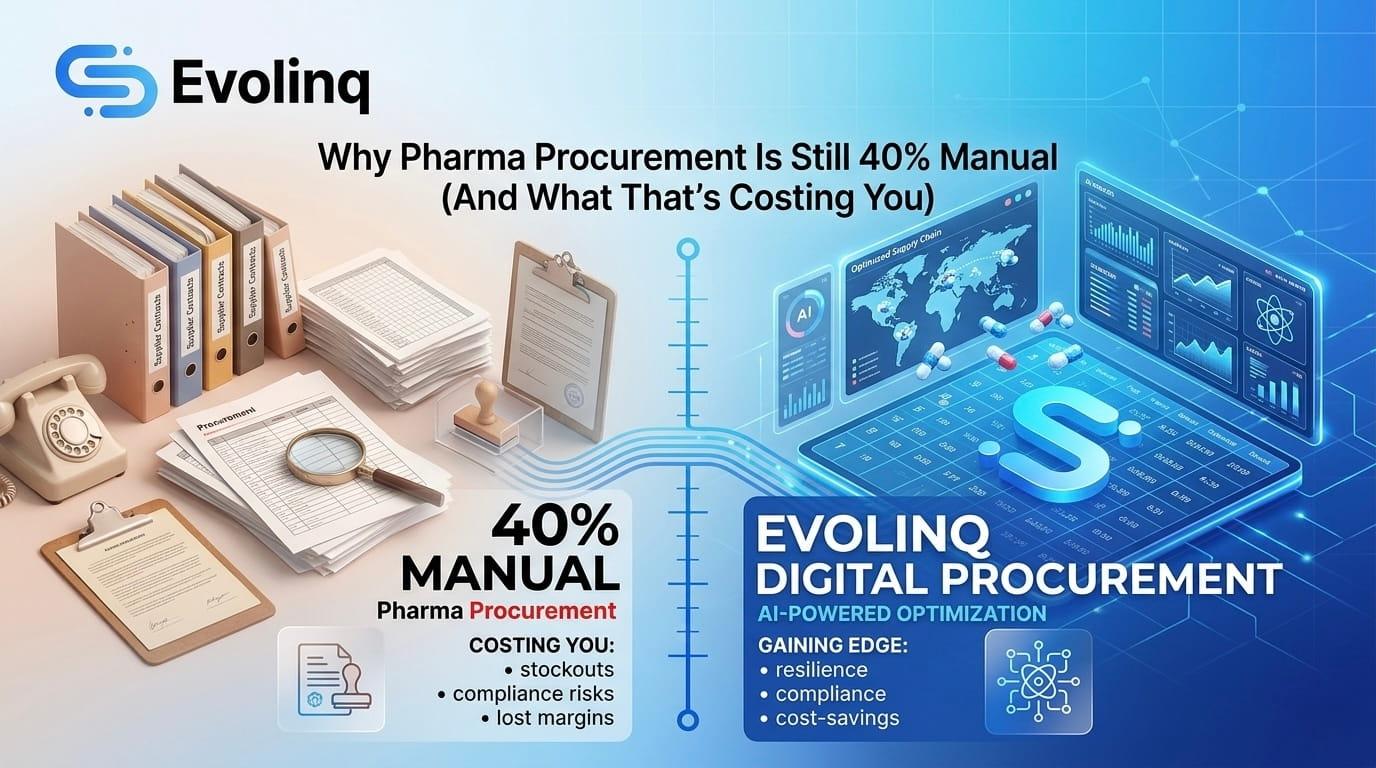
Why Pharma Procurement Is Still 40% Manual (And What That's Costing You)

Noam Shakuri
Pharmaceutical companies spend more on enterprise software per employee than almost any other industry. SAP implementations that cost eight figures. Oracle environments that took three years to deploy. Compliance infrastructure that would make a defense contractor wince.
And yet, if you walk into the procurement operations center of a mid-size pharma manufacturer today, you will find buyers managing supplier relationships through email folders, tracking PO status in shared Excel files, and chasing API suppliers on the phone because a delivery confirmation hasn't arrived in five days.
This is not a technology gap. The ERP is there. The data is there. The gap is at the operational layer — the daily, high-frequency supplier communication that sits between the ERP and the supply base. And in pharma, that gap does not just cost efficiency. It costs production continuity, regulatory standing, and in the worst cases, patient access to medicine.
The Pharma Procurement Paradox
Every pharmaceutical manufacturer above a certain scale has made substantial investment in procurement technology. ERP systems track purchase orders. Supplier qualification databases maintain approved vendor lists. Quality management systems handle documentation. Serialization platforms manage DSCSA compliance.
The investment is real. The gap persists because none of these systems solve the fundamental operational problem: supplier communication is still unstructured, high-volume, and human-dependent.
A pharmaceutical manufacturer sourcing active pharmaceutical ingredients (APIs) from 200 suppliers generates thousands of supplier touchpoints per month. Delivery confirmations. Batch release delays. Certificate of Analysis requests. Shortage notifications. Temperature deviation reports. Each one arrives by email, requires a human to read and interpret, demands a response, and — if it's to be compliant — needs to be logged somewhere with a timestamp.
The ERP stores the PO. The QMS stores the qualification documents. Neither system touches the communication layer in between. That layer is still managed by buyers in their email inboxes.
Why has this persisted despite decades of digital transformation investment? Three structural reasons:
Supplier fragmentation. A large pharma manufacturer may source from hundreds of API, excipient, packaging, and contract manufacturing suppliers — many of them small or mid-size companies in India, China, Eastern Europe, or South America. These suppliers do not have IT departments capable of adopting supplier portals. They communicate by email because email works across every supplier in the network without requiring anyone to install, configure, or maintain anything.
Regulatory complexity. Pharma procurement is not just procurement — it is a regulated function. Every supplier interaction is potentially auditable. GMP documentation requirements, COA requests, deviation notifications, and change control communications all carry regulatory weight. The compliance overhead of any automation solution has historically been a barrier to adoption.
Risk aversion. In an industry where a supply disruption can halt production of a drug that patients depend on, procurement leaders are understandably cautious about changing anything that works. Manual processes are slow and expensive, but they are understood. Automation failure modes are less predictable, and the consequences of a missed supplier exception in pharma are not an annoyed sales team — they are a batch failure or a stockout.
These three factors have created an industry where the most sophisticated ERP environments in the world are connected to a supplier communication layer that runs on email and institutional memory.
The Real Cost of Manual Procurement in Pharma
The efficiency argument against manual procurement is straightforward. The pharma-specific argument is more severe.
API shortages and production line stops
The FDA's drug shortage database consistently lists 100 to 200 active drug shortages at any given time, the majority of which trace back to API supply disruptions. According to FDA reports, manufacturing-related issues — including supply chain failures — account for over 60% of drug shortage causes.
When an API supplier delays a shipment, the buyer who manages that relationship has some number of days to identify the shortage, find an alternative source, and initiate a qualification process before the production line stops. If that supplier's delay notification sits in an email inbox for 18 hours before a buyer notices it — a routine occurrence in any team managing hundreds of supplier emails per week — those are 18 hours of lead time lost. In a pharma supply chain with tight API inventory, 18 hours can be the difference between finding an alternate source and stopping a batch.
Compliance exposure
The FDA's 21 CFR Part 11 and EU Annex 11 regulations require that electronic records used in GMP processes be accurate, reliable, and consistently accessible — with audit trails. DSCSA compliance requires full traceability of pharmaceutical supply chain transactions.
Manual procurement workflows create compliance exposure at every step:
- A buyer sends a COA request by email and the supplier responds. Where is that exchange logged? In the buyer's email folder, inaccessible to the QA team, unsearchable in a form that an FDA inspector can review, and gone if the buyer leaves the company.
- A supplier notifies a buyer of a batch deviation by email. The buyer acknowledges it verbally on a call and intends to log it in the QMS later. "Later" becomes never when the buyer is managing 200 emails that day.
- A change notification from a supplier — a new manufacturing site, a process change that requires re-qualification — arrives by email and sits in a shared inbox for a week before being routed to the appropriate stakeholder.
Each of these is not a hypothetical. They are documented patterns in FDA warning letters and 483 observations issued to pharmaceutical manufacturers. The observation is not "your ERP lacks features." It is "your supplier communication is not traceable."
Clinical trial supply chains
For clinical-stage biotechs, the supply chain stakes are different in kind, not just degree. A clinical trial supply chain that is waiting on an API delivery confirmation may have a fixed enrollment window, a site activation deadline, and a regulatory submission timeline. A five-day delay in a supplier acknowledgment that a buyer didn't notice until day three may cost weeks of clinical schedule — at a cost of hundreds of thousands of dollars per day for a Phase III trial.
These supply chains move at email speed. If the humans in the loop are processing email at human speed — which is necessarily queue-based — the supply chain moves at human-queue speed. That is not fast enough.
Why Pharma Suppliers Don't Adopt Portals
The standard industry answer to the manual supplier communication problem has been supplier portals: platforms that route purchase orders through a web interface, require suppliers to log in and confirm, and create a traceable record. It is a reasonable idea that fails in practice for pharma supply bases.
The failure mode is adoption. A typical pharma manufacturer sources from hundreds of suppliers across India, China, Europe, and the Americas. Many are small, specialized API producers or excipient suppliers with 20 to 200 employees. They do not have IT resources to integrate with a customer portal. They may receive orders from 40 different pharmaceutical customers, each running a different portal. The prospect of maintaining 40 portal logins, learning 40 different interfaces, and routing confirmation workflows through 40 different systems is not viable for a supplier whose IT team is one person who also handles the ERP.
Portal adoption rates in pharmaceutical supply chains are consequently poor — estimates from procurement consulting firms put active supplier portal usage at 20 to 35% of the supply base for most manufacturers. The other 65 to 80% of suppliers remain on email.
EDI is worse. EDI requires both parties to implement technical standards, map data fields, and maintain integrations. The cost per trading partner is prohibitive for small supplier relationships. It works for the largest, most standardized relationships and is effectively inaccessible for the long tail.
The result: every procurement automation initiative that requires supplier behavior change is a partial solution at best. It improves communication with the suppliers who already have IT resources. It does nothing for the suppliers who most need monitoring — the small, specialized, single-source API suppliers who carry the most supply risk.
What Procurement Automation for Manufacturers Changes
The fundamental shift that autonomous AI agents introduce is operating at the receiving end of supplier communication rather than requiring suppliers to change how they communicate.
Evolinq's agents handle pharmaceutical procurement workflows without requiring suppliers to change anything. Suppliers continue sending emails in whatever format they use — confirmation spreadsheets in English or Hindi, batch release notifications in German, deviation reports in Chinese. The agents read, interpret, and act on each communication the moment it arrives.
Automated PO execution with audit trail
When a purchase order is created in the ERP, the agent initiates the confirmation cycle automatically. It composes a confirmation request using the organization's standard format and sends it from the buyer's email address. When the supplier responds — in any format — the agent reads the response, extracts the confirmed quantity and delivery date, writes those values back to the ERP, and sends the supplier an acknowledgment.
Every step is logged: the outbound request (timestamp, content, sender), the inbound response (timestamp, message ID, parsed extraction), the ERP write (timestamp, field, value, confirmation), and the acknowledgment. The audit trail is complete, timestamped, and stored separately from the buyer's email folder. It is accessible to QA and compliance teams without involving the procurement buyer.
Supplier communication in any language
Evolinq's NLP pipeline processes supplier communications in English, Hebrew, Spanish, German, French, Japanese, and Chinese. A pharma manufacturer sourcing from suppliers in India, Germany, and Japan does not need those suppliers to correspond in English for the agent to process their confirmations correctly. The agent identifies language, extracts the relevant data, and writes structured output regardless of source language.
Real-time shortage alerting
When a supplier email indicates a delay, shortage, or capacity constraint, the agent does not queue it for a buyer to review tomorrow. It processes the communication immediately, checks inventory buffer against the production schedule, calculates the days of cover remaining, and — if the situation is below the configured safety threshold — escalates immediately with full context: supplier name, affected POs, inventory analysis, and suggested alternative sources from the approved vendor list.
The difference between a buyer reviewing a shortage notification at 9 AM versus the agent alerting the appropriate stakeholder the moment the supplier's 6 PM email arrives is the entire lead time window available to respond.
Automatic GMP documentation requests
COA requests, batch documentation follow-ups, and re-qualification trigger notifications can be automated based on configurable rules. When a batch delivery is confirmed, the agent can automatically request the Certificate of Analysis if it hasn't been received. When a supplier notification triggers a change control workflow, the agent initiates the documentation request and tracks it through to receipt — without a buyer manually remembering to follow up.
ERP synchronization
All confirmed delivery dates, quantities, COA receipt statuses, and exception flags are written back to the ERP in real time. The ERP record is current. Production planning has accurate data. Quality management can see supplier communication status without asking procurement.
The Compliance Advantage
The counterintuitive result of automating supplier communication with AI agents is that compliance posture improves, not degrades.
Manual supplier communication creates systematic compliance gaps: interactions that should be logged but aren't, audit trails that exist only in email folders, documentation requests that are sent but not tracked through receipt, and exception notifications that are acknowledged verbally but never recorded.
Autonomous agent execution eliminates these gaps by design. Every interaction is logged at the system level, not the user level. The audit trail does not depend on a buyer remembering to copy the QMS or log a note. It is generated automatically as part of the execution process.
For FDA inspections, this means procurement can answer the question "show me all supplier communications related to batch X" in seconds, not hours. The complete interaction history — outbound requests, inbound responses, ERP updates, escalation events — is in a structured, searchable audit log.
For DSCSA compliance, automated traceability of purchase order confirmation and goods receipt creates the supply chain transaction records the regulation requires. The agent's log is not a secondary record; it is the primary record of what happened, when it happened, and what was communicated.
The shift is from compliance as a retrospective documentation effort — reconstructing what happened from email archives after the fact — to compliance as a live characteristic of the operational workflow.
The Teva Reference Point
The scale at which AI can improve pharmaceutical supply chain operations is not theoretical. Teva Pharmaceuticals, one of the world's largest generic drug manufacturers, has publicly reported using AI to boost supply chain resilience tenfold and cut category strategy development time by 90%.
For a company with Teva's scale and resources, that kind of AI implementation represents a significant strategic investment. For mid-market pharmaceutical manufacturers — companies with $100M to $2B in revenue, procurement teams of 10 to 50 people, and supply bases of 100 to 500 suppliers — the same outcomes are achievable at the operational layer, without a multi-year AI program.
Evolinq operates at exactly that layer. It does not require a transformation program. It requires connecting to existing email infrastructure and an ERP environment. The AI that handles supplier communication for a mid-market pharma manufacturer is the same architecture that makes enterprise-scale supply chain intelligence possible — applied to the daily operational problem that enterprise programs often leave unsolved.
The Manual vs. Automated Workflow: A Direct Comparison
| Stage | Manual Process | Time (Manual) | Evolinq AI Agent | Time (Automated) |
|---|---|---|---|---|
| PO issued in ERP | Buyer manually drafts and sends confirmation request email | 5–10 min per supplier | Agent auto-composes and sends from buyer's address | Seconds |
| Supplier confirmation received | Buyer reads email, extracts date and quantity, updates ERP manually | 4–8 min per response | Agent reads, extracts, writes to ERP automatically | Seconds |
| COA request | Buyer sends follow-up email if COA not received, tracks manually | 5–15 min per batch, often missed | Agent auto-requests on delivery confirmation, tracks receipt | Automated |
| Shortage / delay notification | Buyer notices email (hours to days later), manually assesses inventory, escalates | Hours to days | Agent processes on receipt, runs inventory analysis, escalates immediately if critical | Minutes |
| Audit trail creation | Buyer retrospectively logs or not at all | Inconsistent, often missing | Complete log auto-generated at each step | Real-time |
| Supplier exception follow-up | Buyer sends manual follow-up, tracks in email | 5–10 min, easy to drop | Agent sends automated follow-up, tracks to resolution | Automated |
| ERP data currency | Updated when buyer has time | Hours to days after supplier responds | Updated in real time | Real-time |
The aggregate time difference across a supply base of 200 active suppliers is not marginal. At the conservative end of these estimates, manual execution requires 8 to 15 minutes of buyer time per supplier per week just for routine PO tracking and confirmation — 25 to 50 hours per week for a 200-supplier base. That is one full-time employee dedicated to tasks the agent handles in seconds.
The compliance difference is not time-based. It is binary: audit trails either exist or they don't. With manual workflows, they largely don't. With automated workflows, they always do.
Implementation Reality
The hesitation point for most pharma procurement leaders evaluating automation is the implementation. Past experience with ERP projects, supplier portal rollouts, and integration initiatives has calibrated expectations toward multi-month timelines, significant IT involvement, and change management programs that consume more resource than the problem they solve.
Evolinq deploys in one to five business days.
The reason is architectural. Evolinq does not require changes to the ERP. It reads from and writes to specific ERP data objects through standard interfaces. It does not require changes to supplier workflows. It operates at the email layer — the communication channel every supplier already uses. It does not require internal change management beyond configuring the agent's business rules to match the organization's existing procurement policy.
For pharmaceutical manufacturers, there is one additional configuration step that other industries don't require: mapping the automated audit log to the organization's compliance framework. Which interactions need to be linked to the QMS? Which escalations trigger regulatory notification workflows? These are configuration decisions, not development projects. They are completed during the initial deployment process.
The first week of operation typically produces two immediate observations from the procurement team: the inbox volume drops dramatically, and the ERP data is more current than it has been in years. The first week of operation for the compliance team produces one observation: the audit trail now exists.
The Decision
Pharmaceutical procurement has a well-documented gap between its digital infrastructure and its operational reality. That gap persists not because the technology to close it didn't exist, but because previous solutions required supplier behavior change that wasn't achievable at scale.
The architecture that makes AI agents work for pharma procurement is the same architecture that makes them work for any manufacturing procurement: operating at the email layer, handling unstructured supplier responses in any format, and requiring nothing from suppliers except the emails they were already sending.
The compliance benefit is an emergent property of how agents log their work — not a feature that had to be designed separately. The audit trail is a side effect of the execution record.
For a mid-market pharma manufacturer managing 200 suppliers with a procurement team of 15, the question is not whether buyer workload automation is possible. It is how many more stockouts, compliance observations, and lost batch days the organization is willing to absorb before deploying it.
See how Evolinq is built for pharma procurement — book a demo.
Industry data referenced: FDA Drug Shortage Database; FDA 21 CFR Part 11; DSCSA compliance requirements; Teva Pharmaceuticals AI supply chain case study (publicly reported).