The End of the Procurement Manager's Inbox: How AI Agents Handle 1,000 Supplier Conversations Simultaneously

Noam Shakuri
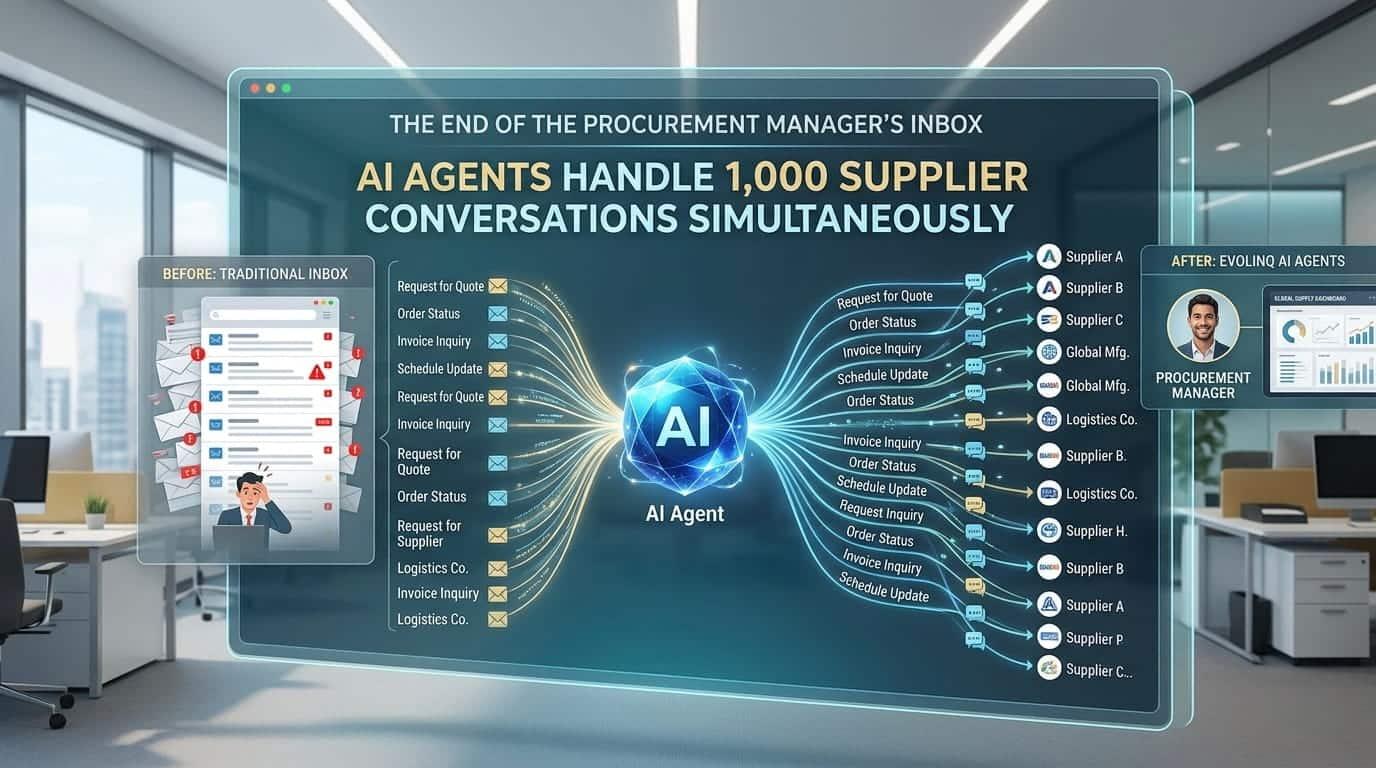
It's 8:07 AM on Monday morning.
Your inbox shows 214 unread emails. Seventeen are flagged urgent. Three subject lines contain the words "delay," two say "shortage," and one from a critical single-source supplier simply reads: "issue with order."
You have a production planning meeting at 9:00 AM, a supplier review at 11:00 AM, and a CEO briefing at 2:00 PM. Somewhere between those three meetings, you're expected to read, triage, respond to, and act on every one of those 214 emails — plus the 60 more that will arrive before noon.
This is not an edge case. This is Tuesday through Friday too.
The modern procurement inbox isn't overwhelmed because procurement teams are understaffed. It's overwhelmed because the entire operational model of supplier communication was designed for a world with 40 suppliers, not 400. And no amount of additional headcount solves a structural problem.
The Scale Problem Nobody Is Talking About
The numbers are stark.
According to the Hackett Group, top-performing procurement organizations have been reducing headcount while managing increasingly complex supplier networks — yet the volume of supplier touchpoints has grown faster than any efficiency gain from traditional tools. The average mid-size manufacturer now maintains active communication with 300 to 600 suppliers, generating thousands of email exchanges per month.
Ardent Partners' State of ePayables and Procurement research consistently shows that procurement professionals cite supplier management and communication as their single largest operational burden. Their surveys across procurement leaders at mid-to-large manufacturers show the average team member handles 300–500 supplier emails per week — messages that require actual reading, contextual understanding, and a decision or response.
The Deloitte Global CPO Survey found that 76% of Chief Procurement Officers identify operational efficiency as their top strategic priority — yet only 17% report that their teams spend the majority of their time on strategic activities. The rest? Manual execution: chasing confirmations, logging delivery dates, resolving discrepancies, and managing the constant back-and-forth of daily supplier operations.
The math compounds quickly. If your organization sources from 400 suppliers, and each supplier generates an average of just three communications per week — a conservative number for active production procurement — you're looking at 1,200 supplier emails per week. At 4 minutes of handling time per email (reading, understanding context, deciding, responding, updating the ERP), that's 4,800 minutes of labor. 80 person-hours per week. Two full-time employees. Just to handle email.
And that's assuming nothing goes wrong. A single shortage event, delayed PO, or pricing discrepancy can cascade into 15 to 20 follow-up exchanges with a single supplier.
Headcount has not scaled with this volume. According to APQC benchmarking data, procurement team sizes at manufacturing companies have grown an average of 8% over the past five years, while supplier network sizes have grown over 30%. The gap is structural, and hiring more buyers doesn't close it.
Why Traditional Tools Don't Solve This
The procurement technology landscape has matured significantly, yet the daily inbox burden remains largely unchanged. Understanding why requires looking at what each category of tool was actually built to do.
ERP systems (SAP, Oracle, NetSuite, Infor) are systems of record. They store purchase orders, vendor master data, and financial transactions with high fidelity. What they cannot do is autonomously communicate with suppliers who operate outside the ERP. Supplier portals built on top of ERPs require suppliers to log in, adopt a new workflow, and enter data manually. Adoption rates are notoriously poor — suppliers who work with 50 different customers cannot realistically maintain 50 different portal logins, and many simply don't.
EDI (Electronic Data Interchange) solved the structured data problem for the largest, most sophisticated supplier relationships. But EDI requires both parties to implement technical standards, map data fields, and maintain integrations. It costs tens of thousands of dollars per trading partner to implement properly and is completely inaccessible for small-to-mid-size suppliers — which make up the majority of most manufacturers' supply bases. EDI covers 15 to 20% of supplier relationships in a typical manufacturing environment. The other 80% still communicates by email.
Procurement platforms like Coupa and SAP Ariba are exceptional at what they were designed for: strategic sourcing, contract management, spend analysis, and compliance workflows. They are not built for the operational layer — the daily, high-frequency supplier communication that drives production. A Coupa implementation does not reduce the number of supplier emails you receive on Monday morning.
Email management tools and shared inboxes add visibility but not resolution. You can route emails more efficiently to the right buyer. You cannot make those emails answer themselves.
The gap left by every tool in the stack is the same: the daily, unstructured, high-volume flow of supplier communications — confirmations, delays, partial shipments, pricing discrepancies, capacity warnings — that lands in your inbox and requires a human to read, interpret, decide, and act.
What Autonomous AI Agents Actually Do
The distinction that matters is between tools that assist procurement professionals and agents that execute procurement tasks autonomously. Most AI in procurement today falls into the first category: dashboards that surface insights, recommendation engines that suggest actions, chatbots that answer queries. Evolinq's approach is different.
Autonomous AI agents handle the full supplier communication loop without human intervention — from the moment a supplier email arrives to the moment the ERP is updated and the supplier has received a response.
Here is what that loop looks like in practice:
Step 1: Inbound email arrives from a supplier. A supplier sends a response to a purchase order confirmation request. The email contains a partially filled Excel attachment, three confirmed line items, one line flagged as delayed by two weeks, and a note about a pricing change on one SKU.
Step 2: The AI agent reads and understands the content. Not keyword matching. Not template parsing. The agent reads the email and attachment with the contextual understanding of what a procurement buyer would extract: which order lines are confirmed, which are delayed, what the revised delivery date is, what the pricing discrepancy is, and what action each item requires.
Step 3: The agent cross-references against ERP data and business rules. The confirmed lines are matched against open purchase orders. The delayed line is checked against the production schedule — is this delay critical, or does it fall within buffer? The pricing discrepancy is checked against the negotiated rate on file. Each determination is made against real data, not guesswork.
Step 4: The agent responds to the supplier. For confirmed items, the agent sends an acknowledgment. For the delay, it sends a follow-up requesting an earlier commitment date. For the pricing discrepancy, it flags the variance and requests clarification or escalates internally based on the configured tolerance threshold.
Step 5: The ERP is updated in real time. Confirmed delivery dates are written back to the ERP immediately. The delayed item is flagged in the system with the revised date. No manual re-entry. No lag between supplier response and internal visibility.
Step 6: Exceptions are escalated to humans. The 5 to 10% of situations that genuinely require human judgment — a supplier proposing a substitute component, a force majeure notice, a negotiation that requires relationship management — are surfaced to the appropriate buyer with full context already loaded.
The critical architectural point: suppliers do not change anything about how they operate. They continue sending emails in whatever format they use — Excel attachments, PDFs, plain text. The AI agent handles the variability. Suppliers at RH Electronics reported no change in their workflow after Evolinq was deployed. They simply noticed that responses came faster and more consistently.
The ROI: A Calculation That Is Difficult to Ignore
Procurement leaders are accustomed to vendor ROI claims that don't survive contact with reality. This one does.
Start with conservative inputs. Your procurement team handles 200 supplier emails per day. Each email requires an average of 4 minutes of handling time — reading, deciding, responding, updating systems. That is 800 minutes per day, or 13.3 hours of manual labor daily just for supplier email.
Across a 250-day working year, that is 3,333 hours — nearly two full-time employees dedicated exclusively to email handling. At a fully loaded cost of $85,000 per procurement employee, that is $170,000 per year in labor cost tied to email.
But labor cost is the smaller number.
The real cost of manual supplier communication is in the decisions that don't get made, the problems that surface too late, and the production disruptions that could have been prevented with earlier visibility.
- A buyer who spends 60% of their day on email triage cannot spend that time on supplier development, risk monitoring, or strategic sourcing.
- A delivery delay that sits unread in an inbox for 18 hours while a buyer is handling other emails is 18 hours of lost lead time for finding alternatives.
- A partial shipment confirmation that isn't logged in the ERP until tomorrow means the production schedule is running on stale data today.
Evolinq reduces the email handling workload to near-zero for routine communications. The math on what that unlocks — in team capacity, in response speed, in risk avoidance — is not marginal. It is structural.
The RH Electronics Proof Point
RH Electronics is one of Israel's largest electronics subcontractors, managing procurement for over 1,000 active suppliers across Israel, Romania, and the United States. Their procurement team of 35 manages more than 15,000 unique SKUs and 25,000 active purchase order lines.
Before Evolinq, distributing a large batch of purchase orders to suppliers took three full days of manual work — cutting Excel rows by supplier, pasting into individual emails, sending, then reversing the process to collect and enter responses. Each buyer was manually logging delivery dates into the ERP line by line.
The consequences were predictable: data entry errors, delayed visibility into supply exceptions, and a team that spent the majority of their time on clerical execution rather than procurement management.
Deployment took one week. Not the months that ERP integrations require. Not the supplier re-education that portal adoptions require. One week, because Evolinq operates within existing email workflows. The AI agents send emails from the buyers' existing addresses, in the format suppliers already receive. Suppliers did not need to change anything.
The results within months of deployment:
- Purchase order distribution reduced from days to a single button click
- 25,000+ purchase order lines automated
- Proactive delivery alerts arriving 2–3 weeks before due dates instead of same-day
- Reduced shortages, fewer delays, lower overstock levels
- PO cycle time shortened from days to hours
- Team capacity redirected from data entry to supplier relationships
"Before, it was truly Sisyphean work — very frustrating," said Shiri Ashton, Operational Purchase Team Leader. "Without the Evolinq system, the work is frustrating. It drags on for hours and sometimes days depending on the volume of lines each buyer has."
The shift was not incremental. It was a fundamental change in what a 35-person procurement team was actually doing with their time.
How Evolinq Compares to Point Solutions
The procurement technology market has produced a category of AI-assisted tools focused on specific parts of the procurement workflow. Understanding where Evolinq sits requires a clear-eyed look at what these tools do and don't do.
ZIP / Levelpath addresses the intake-to-procure workflow — streamlining how purchase requests are created, approved, and converted to orders. This solves a real problem upstream of supplier communication. It does not reduce the volume of supplier emails that arrive once orders are placed.
Coupa and SAP Ariba have introduced AI features for spend analytics, supplier risk scoring, and contract intelligence. These are valuable for strategic procurement functions. They do not touch the daily operational communication layer.
The pattern is consistent: these tools assist procurement professionals in doing their jobs more effectively. They improve visibility, streamline approvals, surface insights. They do not replace the execution layer. A buyer still reads, decides, responds, and logs. The tools make those steps easier; they don't eliminate them.
Evolinq is built to eliminate the repetitive execution layer entirely.
| Activity | Manual Process | Point Solution (ZIP / Levelpath) | Evolinq AI Agents |
|---|---|---|---|
| Reading supplier response emails | Buyer reads each email | Buyer reads email, tool tracks status | Agent reads and understands automatically |
| Extracting data from attachments (Excel, PDF) | Manual copy-paste into ERP | Manual or semi-assisted | Full extraction, zero manual input |
| Responding to supplier confirmations | Buyer writes and sends reply | Buyer sends reply | Agent responds automatically |
| ERP update after supplier response | Manual data entry | Manual or buyer-triggered | Automated, real-time |
| Flagging delayed orders | Buyer notices and escalates | Visibility dashboard | Proactive alert, auto-follow-up sent |
| Handling 400 suppliers simultaneously | Impossible — queue-based | Visibility only | Fully parallel, real-time |
| Supplier workflow change required | No | Varies | No — works via existing email |
| Deployment timeline | N/A | Weeks to months | Days |
The table is not a marketing simplification. It reflects the architectural difference between tools that surface information and agents that take action.
The Competitive Gap Is Widening
Procurement leaders who deploy autonomous agents in the next 12 to 24 months will build operational advantages that compound over time in ways that are difficult for lagging competitors to close.
The first-order effect is efficiency: fewer labor hours on clerical work, faster response cycles, lower error rates. These are visible immediately.
The second-order effect is data quality. When AI agents log every supplier response, confirmation, delay, and discrepancy into the ERP in real time, the quality and completeness of procurement data improves substantially. That data becomes the foundation for better demand planning, more accurate inventory management, and more effective supplier performance reviews.
The third-order effect is supplier relationships. Counter-intuitively, automating routine supplier communication improves relationship quality. Suppliers receive consistent, professional, timely responses every time — not responses that vary based on whether a buyer is having a busy week. Confirmation requests don't slip. Follow-ups don't go missing. The relationship becomes more reliable, not more transactional.
Companies that delay face a different compounding effect. Manual email handling creates a ceiling on how many suppliers a team can actively manage. That ceiling constrains supply base diversification. Constrained supply base diversification increases concentration risk. Concentration risk shows up in shortages and production stoppages.
The procurement function that handles 1,000 supplier conversations simultaneously with the same team that used to handle 200 does not just reduce cost. It changes what is structurally possible.
What Needs to Change (And What Doesn't)
The hesitation among procurement leaders considering this category of technology typically comes from two places: concern about what breaks, and skepticism about what actually works.
What doesn't change: supplier relationships, ERP systems, internal approval workflows, procurement policy. Evolinq operates within existing infrastructure. There is no rip-and-replace. Your suppliers keep emailing you. Your ERP keeps being your system of record. Your team keeps making decisions. The difference is what reaches them.
What does change: the volume of routine tasks that reach the procurement team at all. If 80 to 90% of supplier communications are routine — confirmations, status updates, straightforward delays — then 80 to 90% of the current inbox volume can be handled without a buyer ever seeing it. What surfaces to the team are genuine exceptions: situations that require judgment, negotiation, or relationship management.
This is not a reduction in procurement's importance. It is a redefinition of where procurement's expertise gets applied.
The deployment model matters here. Traditional enterprise software implementations require months of system integration, configuration, and change management. Evolinq's agents deploy in days because they operate at the email layer — the universal interface every supplier already uses. There is no supplier portal to drive adoption of, no EDI mapping to configure, no ERP module to implement. The agents start working immediately because the infrastructure (email) already exists.
The Decision in Front of You
There is a version of this conversation that procurement leaders will have in two years, looking back. Either: "We deployed this early and built two years of advantage while competitors were still debating it." Or: "We waited, and now we're playing catch-up on supplier data quality, team capacity, and risk visibility."
The math is not ambiguous. 13+ hours per day of email handling labor at 200 emails is a recoverable cost if the only benefit were efficiency. The real benefit is what becomes possible when that capacity is redirected, when the data is complete, and when your team is managing exceptions instead of processing routine communications.
The technology is no longer experimental. RH Electronics has 1,000 suppliers and 25,000 active purchase order lines running on it. The deployment timeline is days. Suppliers don't notice anything changed except that responses are faster.
The procurement inbox as it exists today — the 214 unread emails on Monday morning, the shortage alerts buried in the queue, the ERP updates waiting for a buyer to have time — is a solvable problem. Not eventually. Now.
See how Evolinq can take over your supplier inbox — book a demo.
Statistics referenced: Hackett Group procurement benchmarking research; Ardent Partners State of Procurement Research; Deloitte Global CPO Survey 2024; APQC procurement process benchmarking data.