AI in Procurement: A Practical Guide for Manufacturing Companies

Or Feldman
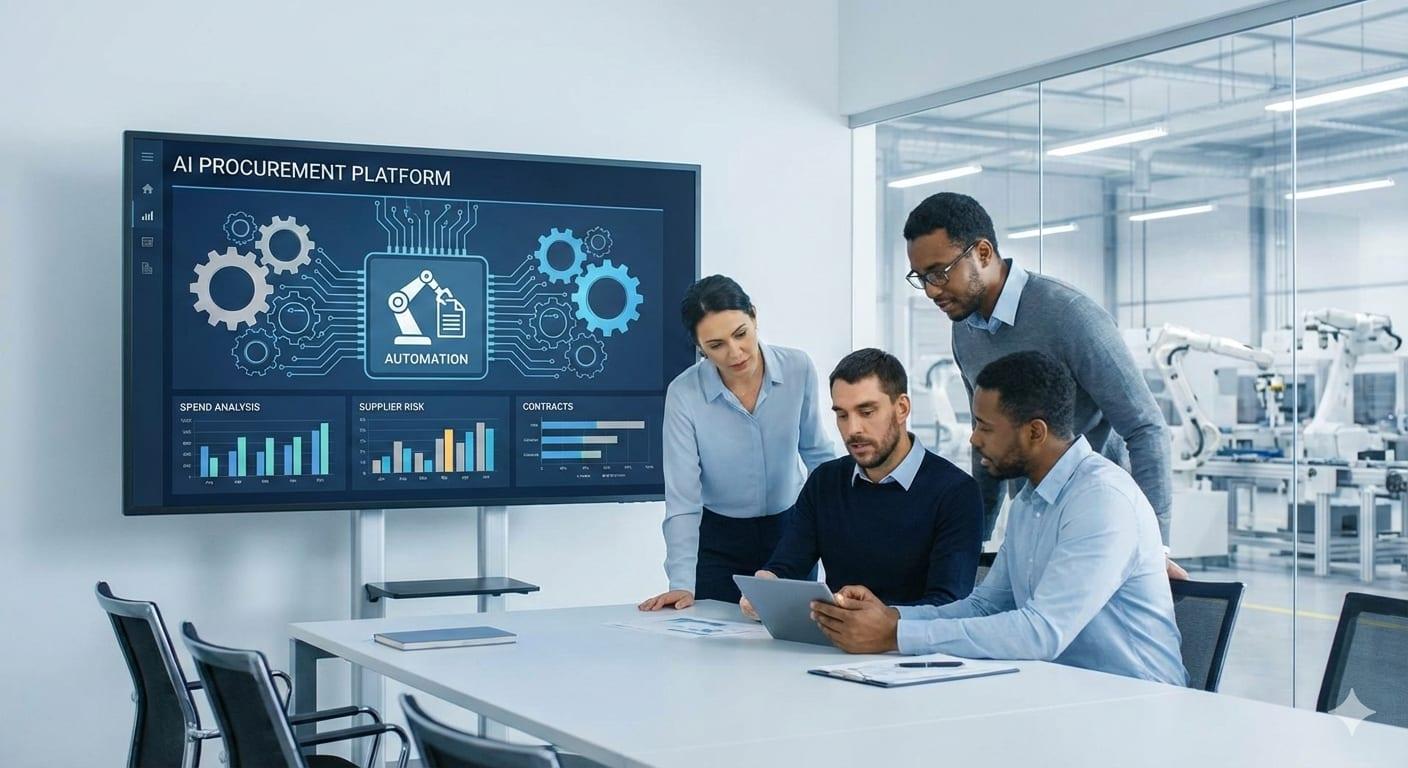
Clearly, procurement automation is no longer optional for manufacturing companies that want to stay competitive. However, implementing AI procurement software effectively requires strategic planning. Automated procurement systems can transform your operations, but only when properly integrated with existing workflows.
In this practical guide, we'll walk you through the essential steps for setting up effective procurement process automation using advanced platforms like Evolinq. From identifying high-impact use cases to preparing your team, we'll share actionable insights to help you capture the full potential of AI in procurement.
Understanding AI in Procurement
AI isn't just another tech buzzword for procurement teams—it represents a fundamental shift in how manufacturing companies approach purchasing processes. Procurement sits at the intersection of massive quantities of data flowing from within organizations (spend, demand patterns, specifications) and external sources (suppliers, market databases).
What artificial intelligence in procurement actually means
In the procurement context, artificial intelligence refers to the capability of machines or computer programs to mimic human intelligence and perform tasks that typically require human intervention. AI-powered procurement tools analyze vast datasets quickly and accurately, providing actionable insights into spending patterns, supplier performance, and market trends. These systems enable procurement teams to predict demand, negotiate contracts, assess supplier risk, and manage the entire procurement lifecycle with unprecedented control.
Furthermore, AI in procurement uses advanced algorithms to improve decision-making, automate repetitive tasks, and analyze vast amounts of spending and supplier data to maximize efficiency throughout the procurement management process.
Key technologies: ML, NLP, RPA, and IDP
Four key technologies form the foundation of AI procurement solutions:
Machine Learning (ML): A subset of AI where algorithms detect patterns in data and use them for prediction or decision-making. ML enables procurement systems to learn from historical purchasing data, identify patterns, and make forecasts without explicit programming.
Natural Language Processing (NLP): Algorithms that interpret, transform, and generate human language. NLP analyzes contracts, extracts key terms, and flags clauses that might pose risks.
Robotic Process Automation (RPA): Software that automates repetitive, rule-based tasks like invoice processing, purchase order creation, and data entry. RPA can reduce costs by 35-65% for onshore operations and 10-30% for offshore operations.
Intelligent Document Processing (IDP): Technology that automates the extraction of data from paper-based documents or document images. IDP combines OCR, NLP, and ML to interpret, classify, and extract data from various document types with up to 99% accuracy.
How AI differs from traditional automation
The primary distinction between AI and traditional automation lies in adaptability. While traditional automation excels at repetitive, predictable tasks using predefined rules, AI systems can adapt to changing environments by analyzing real-time data and making adjustments autonomously.
Additionally, AI introduces learning capabilities through machine learning algorithms. Unlike traditional systems that remain static unless reprogrammed, AI procurement solutions improve over time as they process more data. This continuous learning ensures operations become progressively smarter, driving down costs and enhancing productivity.
Finally, AI's decision-making capabilities mark a significant evolution from traditional approaches. By leveraging complex data analytics, AI systems evaluate vast amounts of information, consider multiple variables, and deliver insights that lead to more informed procurement decisions.
The newest step is agentic AI: instead of suggesting the next action, a procurement agent carries the task through on its own, from contacting the supplier to updating the ERP, and hands exceptions to a buyer.
Setting Up AI for Procurement Workflows
Implementing AI for procurement requires a structured approach to maximize return on investment. Indeed, nearly 80% of global CPOs plan to deploy generative AI within the next three years, yet currently, only 36% of procurement organizations have meaningful implementations. Let me walk you through the essential steps.
Identifying high-impact use cases
Successful AI implementations start with focusing on a small number of high-value use cases rather than attempting to transform everything at once. Organizations that scale analytics successfully typically prioritize just five or six technical solutions annually based on value potential. Top procurement use cases include:
- Spend classification and analysis for identifying cost-saving opportunities
- Supplier risk management to detect potential disruptions
- Contract lifecycle management for better compliance
- Invoice processing automation to reduce manual tasks
The Pareto principle applies here—a handful of well-selected use cases can deliver 60-80% of potential value.
Choosing the best AI procurement software for manufacturers
When selecting procurement AI software, evaluate platforms like Evolinq based on specific capabilities. Look for solutions that not only collect data but interpret it—categorizing spending automatically, flagging anomalies, and recommending cost-saving opportunities. Moreover, ensure the platform offers scalability to grow with your organization.
User experience remains critical—even the smartest software fails if employees avoid using it. Consequently, prioritize intuitive interfaces and solid onboarding support.
Integrating AI with existing procurement systems
Most procurement organizations run legacy procurement management software alongside their ERP. Subsequently, integration capabilities become essential—if the software doesn't communicate with your ERP, it's likely not worth implementing.
Specifically, look for a procurement management system with pre-configured connectors to extract real-time data from your existing systems. This eliminates manual uploads and reduces human error.
Ensuring data quality and accessibility
AI algorithms operate on the "garbage in, garbage out" principle. Therefore, address data quality issues upfront by cleaning and preparing data before feeding it into AI models. Essentially, this means capturing as much relevant procurement data as possible while ensuring it's high-quality, consistent, and complete.
Rather than attempting to fix all data at once, leaders focus on the data needed for high-priority use cases and work backward. This approach ensures every data component processed creates immediate value.
Benefits and Challenges of Procurement Automation
Manufacturing companies adopting AI for procurement are witnessing substantial operational improvements across multiple dimensions. Let's explore these benefits alongside the inevitable challenges that emerge during implementation.
Reducing manual tasks and errors
AI procurement software dramatically cuts time spent on repetitive tasks. McKinsey reports that AI can make procurement 25-40% more efficient, while automation improves data accuracy to approximately 95%. One global consumer goods company uses Evolinq’s decision intelligence to identify purchase-price variance, eliminating manual corrections in supplier communications. Plus, IBM reports that AI can reduce time for basic procurement tasks by up to 80%.
Improving supplier evaluation and contract management
Through AI-powered analytics, organizations gain deeper insights into supplier performance and risk factors. AI systems continuously monitor supplier signals, detecting potential disruptions before they escalate. Contract automation reduces processing times by up to 60% and enables swift document generation with accurate data entry.
Cost savings and faster decision-making
Organizations implementing procurement automation achieve tangible financial gains. According to WorldCC, 92% of time is wasted on inefficient manual contracting. On balance, AI-enabled procurement delivers 15-45% savings across product categories as teams shift from operational tasks to strategic initiatives.
Common challenges: data silos, change resistance, and security
Despite benefits, implementing AI faces obstacles. Data silos remain prevalent—39% of data-driven organizations manage over 50 distinct data silos, hampering effective analysis. Additionally, 94% of senior leaders suffer from technology anxiety around AI. Integration with legacy systems presents further complications, alongside security vulnerabilities created by networked procurement systems.
Preparing Teams and Processes for AI Adoption
The success of AI for procurement depends largely on having a well-prepared team and properly designed processes. Initially, implementing procurement AI isn't just about the technology—it's about building human capability alongside digital transformation.
Training procurement teams on AI tools
Best-in-class companies place 22% of procurement employees in analytics teams. To build essential capabilities, focus on training existing staff on AI fundamentals, tools like Python and SQL, and statistical analysis. Organizations should also consider hiring data scientists and machine learning engineers to develop custom solutions tailored to procurement needs. Above all, a 21-day intensive program can accelerate team-wide AI adoption.
Redesigning workflows for automation
Procurement workflows must be fundamentally redesigned to thrive with AI. Given that most processes were created before AI became widespread, they reflect outdated assumptions about task completion times and roles. Through intelligent automation, new AI capabilities can reduce manual effort by up to 50%. Even more important than buying tools is redesigning processes to capitalize on these efficiencies.
Establishing KPIs and success metrics
Track these key metrics to measure AI's impact: cost savings, contract cycle times, supplier performance, process efficiency, maverick spending reduction, forecast accuracy, and user adoption rates. Create a balanced approach using both leading and lagging indicators. Overall, measuring AI's success means tracking its impact over time, as without measuring outcomes, long-term value is difficult to prove.
Managing change and stakeholder expectations
Start with limited pilot projects before full implementation. Set phased milestones with clear checkpoints where stakeholders can assess progress. To minimize resistance, develop a comprehensive change management plan that includes clear communication about AI benefits. Create a centralized hub of resources to support ongoing learning.
Conclusion
AI procurement implementation represents a transformative opportunity for manufacturing companies, as we've seen throughout this guide. Companies adopting these technologies have significantly reduced costs, minimized errors, and accelerated decision-making processes. Therefore, the question isn't whether to implement AI for procurement, but how to choose the best AI for procurement and roll it out effectively.
Success begins with careful planning and strategic focus. Rather than attempting to transform everything at once, start with a few high-impact use cases that deliver immediate value. Additionally, ensure your data foundation remains strong—clean, accessible information forms the backbone of any effective AI implementation.
Technology alone cannot guarantee success. Your team must be properly trained and prepared for this shift. Most importantly, redesign workflows to capitalize on AI capabilities instead of simply automating outdated processes. This approach maximizes efficiency gains while minimizing disruption.
The path to procurement automation certainly presents challenges. Data silos, resistance to change, and security concerns will arise during implementation. Nevertheless, a thoughtful change management strategy can help overcome these obstacles while maintaining momentum.
Manufacturing companies that embrace AI for procurement today will undoubtedly gain competitive advantages through enhanced operational efficiency, better supplier relationships, and strategic cost savings. The practical steps outlined in this guide provide a roadmap for your organization to begin this journey confidently and capture the full potential of AI-powered procurement with Evolinq.
FAQs
Q1. How can manufacturing companies effectively implement AI in procurement? To implement AI in procurement, start by defining clear goals and identifying high-impact use cases. Begin with a small pilot project, ensure data quality, integrate with existing systems, and provide comprehensive training for your team. Focus on redesigning workflows to maximize AI capabilities and establish key performance indicators to measure success.
Q2. What are the key technologies used in AI-powered procurement? The main technologies in AI procurement include Machine Learning (ML) for pattern detection and prediction, Natural Language Processing (NLP) for analyzing contracts, Robotic Process Automation (RPA) for automating repetitive tasks, and Intelligent Document Processing (IDP) for extracting data from various document types.
Q3. What benefits can manufacturing companies expect from implementing AI in procurement? Manufacturing companies can expect significant benefits, including reduced manual tasks and errors, improved supplier evaluation and contract management, substantial cost savings, and faster decision-making. AI can make procurement 25-40% more efficient and deliver 15-45% savings across product categories.
Q4. How should teams prepare for AI adoption in procurement? Prepare teams by providing training on AI fundamentals and relevant tools. Consider hiring data scientists and machine learning engineers for custom solutions. Redesign workflows to capitalize on AI capabilities, establish clear KPIs, and develop a comprehensive change management plan to minimize resistance and support ongoing learning.
Q5. What are the common challenges in implementing AI for procurement? Common challenges include dealing with data silos, overcoming resistance to change, ensuring data quality and accessibility, integrating with legacy systems, and addressing security concerns. It's crucial to have a structured approach to data management and a well-planned change management strategy to overcome these obstacles.
Q6. How can AI help in procurement? AI takes over repetitive execution work: confirming POs, following up on late lines, updating ERP dates and flagging at-risk deliveries. Buyers keep negotiation and supplier strategy.
Q7. Where should a procurement team start with AI? Start with one high-volume, rules-based workflow, such as PO acknowledgements or delivery follow-ups. Measure hours saved and on-time delivery for 30 days, then expand.
Q8. What is the difference between an AI copilot and an AI agent in procurement? A copilot suggests and drafts while a person acts. An agent carries the task through, for example contacting the supplier and updating the ERP, and escalates exceptions to a person.