Agentic AI vs. AI Assistants in Procurement: Why 'Copilot' Is the Wrong Model

Noam Shakuri
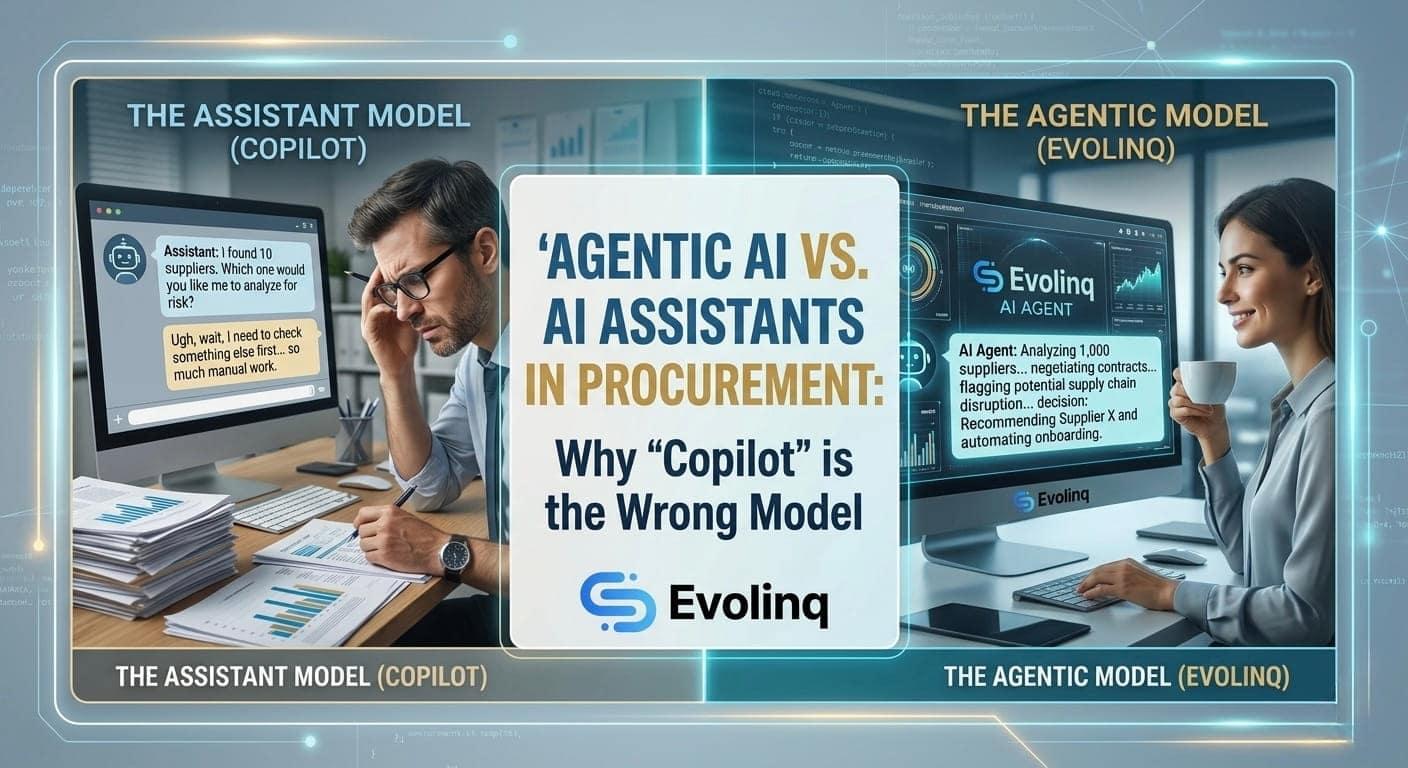
The procurement software industry has a vocabulary problem.
In the past three years, nearly every major vendor has rebranded some portion of their product as "AI-powered." Coupa has AI. SAP Ariba has AI. New point solutions launch weekly with AI in the name. And the category that has attracted the most marketing attention — and the most investment — is the AI copilot: a tool that sits alongside a procurement professional, suggests actions, drafts communications, and flags anomalies.
Copilots are useful. They are also, for operational procurement, the wrong model entirely.
This post is about why — and about what the right model looks like, what it can actually do, and how to evaluate whether an AI procurement tool is a genuine agent or just a faster human assistant.
The Three Tiers: A Framework That Actually Matters
Before arguing that copilots are the wrong model, it's worth being precise about what each tier of AI actually does. The distinctions are not semantic. They have direct operational implications.
Tier 1: AI Assistants
AI assistants automate the mechanical parts of existing workflows without changing the decision structure. Examples in procurement:
- Autocomplete for purchase requisitions based on historical data
- Spend dashboards that surface category-level insights
- Anomaly detection that flags unusual invoices for review
- Search tools that retrieve supplier contracts faster
In every case, a human still looks at the output, evaluates it, and decides what to do. The AI reduced keystrokes or search time. The decision loop is unchanged.
Tier 2: AI Copilots
Copilots go further — they generate content and recommend actions, not just surface information. Examples in procurement:
- Drafting a supplier delay response email for a buyer to review and send
- Recommending which supplier to escalate based on on-time delivery history
- Summarizing a supplier's email thread so a buyer can respond faster
- Pre-populating a change order form based on inbound supplier communication
Here, the AI is doing substantive work. But the human is still required at every decision point: reviewing the draft, approving the recommendation, hitting send. The procurement team is faster, but the bottleneck is still headcount — every action that leaves the building still requires a pair of human eyes.
Tier 3: Agentic AI
Agentic AI operates within defined guardrails to make decisions and execute actions autonomously — without waiting for human approval on routine tasks. Examples in procurement:
- Sending order confirmation requests to 200 suppliers and processing all responses without a buyer seeing any of them
- Identifying a delivery delay from a supplier, checking the inventory buffer, determining that risk is below threshold, and updating the ERP — without escalation
- Extracting confirmed delivery dates from a PDF attachment, writing them to the ERP, and sending the supplier an acknowledgment, all within seconds of the email arriving
The human is not in the loop for routine execution. They receive escalations — the genuine exceptions that require judgment. Everything else runs.
This is not a marginal improvement on the copilot model. It is a different architecture for how procurement work gets done.
The Copilot Trap
Copilots became the dominant AI model in enterprise software for understandable reasons. They're safer to deploy — humans review every output. They're easier to sell — no one needs to explain autonomous decision-making to a risk-averse procurement team. And they produce visible, immediately legible value: a buyer can see the draft email the AI wrote and evaluate whether it's good.
But the copilot model has a structural limitation that its proponents rarely acknowledge openly: it does not remove procurement from the throughput constraint.
Consider the math. If a procurement team handles 200 supplier emails per day, and a copilot reduces the handling time per email from 4 minutes to 2.5 minutes, the team is now faster. But they still need to touch all 200 emails. They still need to read the AI's draft, assess whether it's correct, approve or modify it, and send it. The total handling time drops from 800 minutes to 500 minutes. That is a real improvement — roughly two hours recovered per day.
It is not, however, a solution to the structural problem. The procurement team's capacity still constrains how many suppliers can be actively managed. The inbox still fills every morning. The ERP still waits for humans to update it. The copilot made the humans 38% faster. The work did not go away.
There is also a cognitive cost that copilot vendors understate. Context-switching between supplier communications — reading a draft, evaluating it against real order data, adjusting terminology, approving — is mentally expensive. Doing that 200 times per day, even at 2.5 minutes per email, produces decision fatigue that degrades the quality of judgment on the things that actually matter. The 10% of supplier situations that genuinely require strategic thinking get less attention, not more, because the 90% that should be routine still demands cognitive load.
Agentic AI removes the routine 90% from the decision stack entirely. The procurement team's cognitive resources are reserved for the 10% that justifies their expertise.
What Agentic Procurement Actually Looks Like
It is 6:47 AM. The procurement manager at a mid-size electronics manufacturer has not yet had their first cup of coffee. Their Evolinq agent has been running for the past four hours.
Here is what has already happened:
The agent connected to the ERP at 3:00 AM, identified 47 purchase orders due for supplier confirmation this week, and began the confirmation cycle. For each order, it checked the supplier record, pulled the relevant contact, composed a confirmation request using the organization's standard format and the buyer's sending address, and dispatched it. All 47 went out by 3:22 AM.
By 6:00 AM, 31 of those suppliers had responded. The agent read each response — some plain text emails, three Excel attachments, one PDF with a delivery schedule. It extracted confirmed quantities and dates, cross-referenced them against the open POs in the ERP, and wrote confirmed delivery dates directly to the system. 28 of the 31 responses required no further action. The agent acknowledged each supplier automatically and moved on.
Three responses flagged issues:
-
Supplier A confirmed 80% of the order quantity with the remaining 20% pushed out three weeks. The agent checked inventory buffer against the production schedule. Buffer is sufficient; no production impact. It updated the ERP with the partial confirmation, noted the shortfall, and filed a follow-up task for the buyer's weekly review.
-
Supplier B sent an email saying their factory is at reduced capacity due to a maintenance shutdown and cannot confirm the delivery date yet. The agent identified this as a genuine exception — capacity issues at a key single-source supplier for a critical component — and escalated to the appropriate buyer with full context: supplier name, order details, buffer status, alternative sourcing options from the vendor master, and recommended action.
-
Supplier C's response was in a format the agent could not parse with confidence. It escalated to the buyer with the raw email attached and a note indicating the issue.
By 6:47 AM, when the procurement manager opens their laptop, their inbox contains two escalations. Not 47 supplier emails to work through. Two escalations, pre-loaded with context, requiring actual human judgment. The other 45 orders are already moving.
This is not a hypothetical. This is what Evolinq's agents do every morning, at scale, for organizations managing hundreds of suppliers and thousands of open purchase order lines.
The 5 Criteria for True Agentic Procurement AI
Not everything marketed as an agent is one. The following five criteria distinguish genuine agentic procurement AI from copilot tools with better branding.
1. Reads and understands unstructured supplier communication
Real supplier communication is not structured. Suppliers send Excel files with non-standard column headers, PDF attachments with delivery schedules embedded in tables, plain-text emails mixing confirmations with questions, and occasionally WhatsApp messages. An agent that can only handle templated inputs is not operating in the real procurement environment.
True agentic procurement AI uses NLP to read and interpret supplier responses in whatever format they arrive — extracting the information that matters (confirmed quantities, delivery dates, exceptions, pricing changes) without requiring suppliers to standardize their output.
2. Makes context-aware decisions without human approval for routine tasks
An agent that flags every anomaly for human review is a dashboard with extra steps. True autonomy requires the agent to evaluate context — inventory levels, production schedule, historical supplier performance, order criticality — and make a determination: does this situation require escalation, or can it be resolved within defined parameters?
This requires access to real ERP data, not just the email. An agent that reads supplier communications in isolation cannot make context-aware decisions.
3. Executes actions autonomously — sends emails, updates ERP, generates alerts
Reading and deciding are not enough. The agent must be able to act: send the response to the supplier, write the confirmed date to the ERP, generate the alert, create the follow-up task. An agent that produces a recommended action for a human to execute is a copilot.
4. Requires zero change from suppliers
This criterion eliminates most portal-based and EDI-based "automation" solutions. If deploying the system requires convincing 400 suppliers to log in to a new portal, change how they format their responses, or install new software, the adoption friction defeats the efficiency gain. A genuine agent operates in the communication channel suppliers already use — email — and handles whatever they send.
5. Escalates intelligently — only genuine exceptions reach humans
The value of an agent is not just what it handles; it is what it correctly declines to handle. An agent that escalates too aggressively recreates the inbox problem. An agent that escalates too narrowly creates risk. The calibration between autonomous execution and human escalation is the core of what makes an agent trustworthy.
Intelligent escalation requires the agent to understand what it doesn't know, flag situations where its confidence is low, and surface genuine exceptions — not just anything it finds difficult.
Agentic AI vs. Copilot vs. Assistant: Where Evolinq Stands
| Criterion | AI Assistant | AI Copilot | Agentic AI (Evolinq) |
|---|---|---|---|
| Reads unstructured supplier emails and attachments | No — structured inputs only | Partially — with human review | Yes — NLP on email, Excel, PDF |
| Makes decisions without human approval | No | No — every action requires approval | Yes — autonomous on routine tasks |
| Sends supplier communications autonomously | No | No — drafts only | Yes — sends on behalf of buyer |
| Updates ERP without human trigger | No | No | Yes — real-time, direct integration |
| Handles 400 suppliers simultaneously | No — human bottleneck | No — human bottleneck | Yes — fully parallel |
| Requires supplier onboarding or portal adoption | No | No | No — works via existing email |
| Intelligent escalation to humans | No — all output goes to humans | Partially — flags for review | Yes — genuine exceptions only |
| Deployment timeline | Days to weeks | Weeks | Days |
| Works with SAP, NetSuite, Infor | Varies | Varies | Yes |
The pattern across the table is consistent. AI assistants and copilots both preserve the human as a required node in the execution loop. Agentic AI removes the human from the execution loop for routine work, while keeping them precisely and efficiently involved for work that genuinely requires judgment.
The Business Case: What Happens When Execution Runs Itself
The operational implications of removing humans from routine procurement execution compound across three dimensions.
Workload reduction
When routine supplier communications — confirmations, acknowledgments, status updates, data extraction, ERP updates — run autonomously, the manual workload for procurement teams drops by 80% or more for those task categories. At RH Electronics, a 35-person procurement team managing 1,000+ suppliers and 25,000 active purchase order lines reduced PO distribution from three days to a button click after deploying Evolinq. That is not a 38% efficiency improvement. It is a structural elimination of the bottleneck.
PO cycle time
When an agent processes supplier confirmations within seconds of receipt rather than hours or days after a buyer has a chance to open the email, PO cycle times compress dramatically. At scale, this changes the planning horizon available to the organization. A 2-week confirmation cycle that compresses to 2 hours changes what is possible in production planning and inventory management.
Supplier re-education cost: zero
Because Evolinq operates via email and handles unstructured responses, there is no supplier onboarding process. Suppliers continue sending emails in whatever format they use. The agent adapts to them. This eliminates what is typically the largest hidden cost in procurement automation projects: change management for hundreds of suppliers.
Deployment timeline: days
Traditional procurement automation requires ERP integration projects that take months. Evolinq agents connect to SAP, NetSuite, and Infor environments through standard interfaces and are configured in days. Organizations are live in the same week they decide to proceed.
Objections, Answered Directly
"What about accountability? Who is responsible when the AI makes a decision?"
The organization is, the same way it is accountable for the decisions made by its procurement team. Evolinq operates within guardrails defined by the organization: approval thresholds, escalation triggers, supplier communication templates, and ERP update rules. Every action the agent takes is logged and auditable. If a buyer would not be permitted to autonomously confirm an order above a certain value, the agent is configured with the same constraint.
Accountability does not require a human to be in the loop for every routine action. It requires that every action is traceable, reversible where appropriate, and constrained by organizational policy. Agentic procurement AI satisfies all three.
"What if the agent makes a wrong decision?"
It will, occasionally. So do buyers. The more relevant question is: does the agent make the same quality of decision as a buyer would on routine tasks, and does it escalate correctly when it is uncertain?
The answer to both is yes for well-designed agents. NLP accuracy on structured information extraction from supplier emails is high and improving. The escalation logic — flagging situations where confidence is low or where defined thresholds are exceeded — is precisely where engineering investment goes. An agent that is wrong 1% of the time on routine tasks and escalates the rest is better than a buyer who is accurate 98% of the time but processes 200 emails at degraded attention levels by 4 PM.
More importantly: the agent's error rate on routine tasks is a known, measurable, improvable number. Human error rates on repetitive high-volume tasks are also measurable, and not as flattering as we tend to assume.
"How does it integrate with our ERP?"
Evolinq connects to SAP, NetSuite, and Infor through standard API and file-based interfaces. The agent reads open purchase orders from the ERP, writes confirmed delivery dates and status updates back to the ERP, and generates exception records for buyer review — all in real time. No custom integration project is required. The connection is configured during the deployment process, which takes days, not months.
The Decision You Are Actually Making
When a procurement leader evaluates AI tools, the decision is not really about technology. It is about what kind of operational model the procurement function should run on.
The copilot model says: procurement professionals are knowledge workers who should be supported and accelerated by AI. This is a reasonable belief. It is also a belief that preserves the human as a throughput constraint on every task, including the 90% that do not require knowledge work.
The agentic model says: most of what procurement professionals spend their time doing — reading supplier emails, extracting data, updating systems, sending confirmations, following up — is not knowledge work. It is execution. AI should own execution. Humans should own judgment.
This is not a theoretical distinction. It is the difference between a procurement team that is 38% faster and one that has its capacity structurally reallocated to the work that actually requires their expertise.
The organizations that adopt the agentic model in the next 12 to 24 months will build operational capabilities that cannot be replicated by organizations running faster copilots. The gap is not in speed. It is in what becomes structurally possible when execution no longer requires human attention.
Copilots are a thoughtful answer to the wrong question.
See an Evolinq agent run live — book a demo.
Product references: Evolinq agents integrate natively with SAP, NetSuite, and Infor ERP systems. Deployment timeline: 1–5 business days. No supplier onboarding required. Agents operate via existing email infrastructure.